
Understanding Corporate Event
AV Costs
What You’re Paying For and How to Recognize Real Value
Most planners begin comparing AV proposals by looking at the number on the last page. That makes sense.
The total has to fit the budget. Someone will ask why one company costs more than another. And when two proposals appear to describe the same event, price feels like the cleanest way to
compare them.
But it may be the least useful comparison.
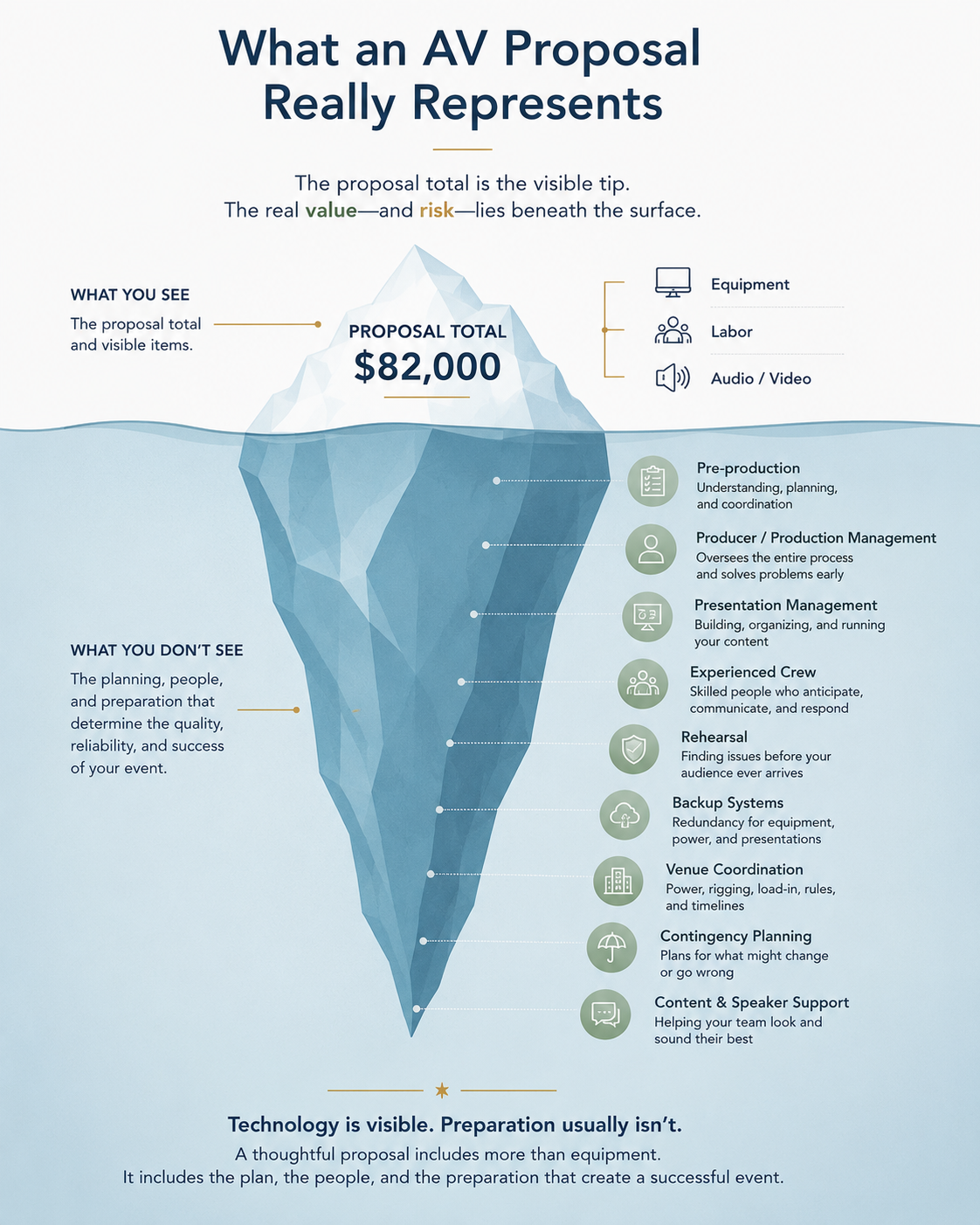
One company may be planning for in-person pre-production, experienced operators, a complete rehearsal, redundant presentation systems, and enough setup time to have the room ready when your CEO walks in.
Another may be planning to deliver equipment and find out what you need onsite. Those are not two prices for the same thing.
They are two different plans.
Understanding corporate event AV costs begins with understanding the event each company is actually proposing to produce.
Why event production quotes can be so different
Send the same event information to three production companies and you may receive three dramatically different totals.
It is tempting to assume one company is expensive, another is competitive, and the third really wants the business.
Maybe.
But there is usually more happening underneath the numbers. Each production company makes assumptions about the event. Some will ask enough questions to confirm those assumptions. Others will build a quote using the information available and hope the details can be sorted out later.
Those assumptions affect:
- How much planning is included
- How many people will be onsite
- How experienced those people will be
- How much setup time the crew receives
- Whether rehearsal is included
- Who will manage presentations
- Whether backup systems are provided
- How much support the planner and speakers will receive
- What happens when the program changes
Here is what surprises people.
Two equipment lists can look almost identical while representing very different productions. The difference is often found in the work surrounding the equipment.
A proposal should show that the company understands the event
Before a production company gives you a solution, it should understand what you are trying to accomplish.
That requires a conversation.
Preferably more than one.
We believe in meeting in person as early as possible. It is where we learn what the event is about, what the organization cares about, how the room should feel, which moments matter most, and what has gone wrong before.
If an AV company does not want to spend time understanding your event before show week, it probably is not the right production partner.
Pre-production is not a courtesy added to the equipment rental.
It is part of the product.
A thoughtful proposal should reflect those conversations. It should describe what the company plans to deliver and how that plan supports the event.
Most AV proposals start and end with an itemized list.
Projector.
Screen.
Switcher.
Microphones.
Labor.
An itemized list can be useful, and we provide one when a client needs it. But an equipment inventory does not tell you whether the company understands the production.
A good scope of work should.
It should give you confidence that the company understands the goals, audience, program, tone, and technical demands of the event.
“Trust us. You’ll love this” is not a scope of work.
It is a place to hide assumptions.
What you are actually paying for
Equipment is an important part of a corporate AV budget. It is still only one part.
Production management
Someone has to translate the event plan into a production plan.
That person coordinates with the planner, venue, speakers, creative team, and technical departments. They help establish the schedule, identify missing information, manage changes, and keep the different parts of the show moving in the same direction.
Strong production management reduces the number of problems the planner has to discover and solve.
That value can be difficult to see on a quote because much of the work happens before anyone enters the ballroom.
You tend to notice when it was not included.
Technical labor
Good show labor is not cheap.
It is also a game changer.
Experienced technicians do much more than operate equipment. They anticipate cues, communicate with other departments, recognize problems early, and make corrections without distracting the audience.
Consider the presentation position during a polished general session.
Some clients try to save money by assigning an employee to run every presentation from a company laptop. On paper, that can look like an easy place to reduce the budget.
In the room, that person is central to the entire show.
They may be responsible for loading and checking presentations, advancing slides, managing edits, coordinating with the show caller, sending content to multiple screens, operating confidence monitors, displaying speaker timers, and responding instantly when the program changes.
That is not a spare assignment for someone who is also answering email.
And then there is the company laptop.
It installs an update. A notification appears over the CEO’s slide. The presentation freezes because the machine was never configured for continuous show playback. An adapter that worked yesterday decides it has done enough.
We have opinions about client laptops.
A professional presentation system includes properly prepared machines, experienced operators, disciplined file management, and a backup plan.
The audience may never notice any of that.
That is the point.
Equipment
Equipment costs depend on the size of the room, audience, program format, number of screens, content requirements, and technical complexity.
Common categories include:
- Audio systems
- Microphones
- Projection or LED displays
- Video switching and playback
- Lighting
- Cameras
- Recording
- Streaming equipment
- Staging and scenic elements
- Communication systems
- Backup equipment
More equipment does not automatically create more value.
The right equipment solves a defined problem.
Content support
Presentations, videos, graphics, walk-in loops, speaker titles, countdowns, and other media all need to be collected, checked, organized, and played at the correct moment.
Some productions require a dedicated presentation manager. Others need graphic design, video editing, or original video production before the event.
The production company’s role should be clear.
Who collects the files? Who checks formatting? Who manages revisions? Who has authority to approve the final version? What happens when a speaker arrives with a new deck?
“Someone will handle it” is not a reliable workflow.
Rehearsals
Rehearsal time includes more than a speaker standing at a lectern and reading through slides.
It may require the full video team, audio team, lighting team, presentation operator, stage manager, producer, and show caller.
That labor can make rehearsal look expensive.
But the purpose of rehearsal is to discover uncertainty while there is still time to do something about it.
The CEO should not be the person who discovers that the confidence monitor is difficult to read.
Creative planning
Some events need more than technical execution. They need full event design.
They need help shaping the opening, building a visual identity, creating media, improving transitions, or deciding how to hold the audience’s attention.
For the Marriott Engineering and Facilities Conference, Five Stone helped develop the theme, messaging, brand identity, and content before producing the final conference experience. The technology mattered, but its value came from supporting a larger creative plan.
Venue-related costs
A production proposal may not include every cost controlled by the venue.
These can include:
- Rigging
- Power
- Internet
- Loading fees
- Security
- Union or venue labor
- Outside vendor fees
- Lift rentals
- Tables and room furnishings
- Storage
- Overnight access
Ask which venue expenses are included in each proposal and which will be billed separately. Otherwise, one proposal may look less expensive simply because more of its cost is waiting somewhere else.
Freight and logistics
Equipment and people have to reach the venue at the right time.
Freight, trucking, travel, lodging, parking, per diem, and local transportation may all affect conference AV pricing.
For a multi-city event, logistics become part of the production design. Five Stone’s work on the Amazon PXT Academy required six events across multiple cities in three weeks. In that environment, a plan that works in one ballroom is not enough. It has to travel.
Contingency planning
Backup systems cost money.
So does failure.
The appropriate level of redundancy depends on the event. A small breakout session and a globally streamed leadership announcement do not carry the same risk.
A thoughtful proposal should identify which systems require backups and why.
For live streaming, that might include redundant internet, backup encoding, secondary playback, or local recording. For a general session, it may mean spare microphones, backup presentation machines, or alternate signal paths.
Contingency should be designed around consequences, not fear.
Why the lowest proposal is not always the lowest cost
A lower-priced proposal can be an excellent choice.
Sometimes one company owns its equipment. Sometimes it has a more efficient solution. Sometimes the event simply does not require the larger plan another company proposed. Lower price does not mean lower quality.
But lower scope usually means lower price.
The question is whether you can see the difference.
Common omissions include:
- Pre-production
- Rehearsal labor
- Sufficient setup labor
- Presentation management
- Backup systems
- Rigging
- Power
- Internet
- Freight
- Venue fees
- Travel
- Overtime
- Post-production
- Support for last-minute changes
Skimping on setup labor is especially dangerous.
If the room is not ready when the CEO arrives for rehearsal, everyone looks bad.
The executive sees an unfinished stage. The planner begins making calls.
The crew is forced to test systems while leadership is waiting. Rehearsal gets shortened, and the show begins carrying problems that should have been resolved hours earlier.
Setup labor does not look exciting on a proposal.
Neither does having the room ready.
Until it is not.
Change orders deserve attention too. Events evolve, and legitimate scope changes should affect the price. But a low initial proposal can become expensive if important, predictable requirements were excluded and added later.
Ask how changes are priced and documented.
A proposal is not complete because it has a total at the bottom.
It is complete when you understand what the total includes.
Where spending more creates value
The best place to invest is not always the place the audience can photograph.
Audio
Do not shortcut audio.
An audience may tolerate a less elaborate stage. They will not remain engaged if they cannot understand the speaker.
Audio design should account for the room, seating, program, microphones, playback, and audience interaction. Skilled audio technicians are equally important.
If the message cannot be heard clearly, the rest of the production is decoration.
Presentation management
A dedicated presentation team creates value far beyond advancing slides. For complex general sessions, video may require three or four technicians. That number can surprise clients. But consider what the system may be doing at once:
- Sending different content to multiple screens
- Playing videos from several sources
- Managing speaker presentations
- Feeding downstage confidence monitors
- Running speaker timers
- Switching cameras
- Creating records or streams
- Preparing the next session while the current one is running
Each output needs to happen at the correct moment.
The person operating the machine matters as much as the machine.
Rehearsal
More rehearsal does not guarantee a better speaker.
It does create time to solve technical and production problems before an audience is present. For high-stakes general sessions, rehearsal is one of the most practical ways to reduce risk.
Producer oversight
A strong producer holds the whole event in view.
They understand what the planner needs, what the creative team is building, what the technicians require, and what the audience will experience.
Without that role, each department may execute its assignment correctly while the event itself feels disconnected.
Content integration
Relevant media can change the energy of a room.
Video can explain a complex idea, create an emotional turn, give the audience a visual reset, or allow a story to be told by the person closest to it.
But content creates value only when it is integrated into the program.
The goal is not to play more videos.
The goal is to make the next few minutes matter.
Experienced crew
Experience creates speed, judgment, and calm.
At a large conference like Get Your Teach On, where more than 4,300 educators gathered for a national event, audio, lighting, projection, video capture, and streaming had to operate as one production. That requires skilled people who understand both their positions and the show around them.
This is the larger point.
Good labor does not merely operate the production.
Good labor protects it.
Where you may be able to spend less
A trusted production partner should be willing to tell you when something is unnecessary.
Believe it or not, that sometimes includes LED walls.
LED walls are beautiful. They are bright, flexible, and often the right solution. We deploy them
regularly.
They are also expensive and trendy.
Understanding why the client wants one is the key.
Does the room have ambient light that makes projection difficult? Does the scenic design require a particular shape? Is the event being filmed in a way that benefits from LED? Does the screen need to remain bright in conditions that cannot be controlled?
If the answer is simply “We saw one at another conference,” there may be a better use for the budget.
High-end projection still produces beautiful images. Pair it with thoughtful lighting and scenic choices, and it can create an impressive in-room experience for substantially less than an LED solution.
This is where production philosophy becomes visible.
One company hears “LED wall” and adds an LED wall.
Another asks what you want the room to feel like.
Other possible savings may include:
- Reducing screen size when sightlines allow it
- Simplifying decorative lighting
- Using fewer cameras when recording or streaming goals are limited
- Removing technology that does not support the program
- Reusing scenic or content elements
- Adjusting the schedule to reduce overtime
- Matching redundancy to the actual risk
- Concentrating the budget on the general session instead of treating every room equally
Lighting can often be approached several different ways.
Audio is different.
There are many places to become more efficient. Making the message difficult to hear should
not be one of them.
How to make competing AV proposals comparable
Before comparing totals, normalize the plans.
1. Confirm the scope
Make sure each company is pricing the same rooms, dates, sessions, audience size, program format, recording requirements, and streaming needs.
2. Separate included and excluded costs
Identify which venue, travel, freight, internet, power, rigging, and labor costs appear in the proposal. Create a second list for costs that will be billed elsewhere.
3. Review the assumptions
Look for assumed setup times, rehearsal schedules, show hours, content formats, room access, and venue capabilities. If assumptions are not listed, ask for them.
4. Compare roles, not headcount
Four technicians on one proposal may not perform the same work as four technicians on another. Ask what each onsite person will be responsible for and who has overall authority for the show.
5. Walk through the event chronologically
Start with load-in and continue through setup, testing, rehearsal, show, strike, and post-production.
Is the room ready when it needs to be?
Who is present at each stage?
Where are overtime or schedule risks hiding?
6. Ask what happens when something changes
How are revised presentations managed? What happens when a speaker runs long? Who can approve additional costs? What backup systems are included?
The answers reveal whether you are reviewing an equipment order or a production plan.
Questions to ask before choosing a proposal
- Use these questions with every company:
- What is included in this proposal?
- What is specifically excluded?
- What assumptions did you make?
- What pre-production is included?
- Will we meet in person before the event?
- Who will manage the production?
- Who will manage presentations?
- Who will actually be onsite?
- How much setup and testing time is included?
- Which crew members will attend rehearsal?
- What backup systems are included?
- What venue-controlled costs are not represented?
- How are overtime and schedule changes billed?
- How are last-minute content changes handled?
- What would you add if the budget increased?
- What would you remove if the budget decreased?
- Why are you recommending this specific design?
That last question matters.
A fair proposal should be explainable.
The real measure of value
Fair does not mean cheap.
It does not mean expensive either.
Fair means the costs are explained and justified according to the client’s stated needs.
A production proposal is more than a list of equipment and labor. It is a plan for what will happen when the crew enters the room, when the CEO arrives for rehearsal, when the doors open, and when something changes five minutes before a session.
The largest proposal is not automatically the best plan.
The lowest proposal is not automatically the best value.
And the proposal with the most equipment may have the least imagination.
Real value comes from intention.
The right people are doing the right jobs. The equipment supports the purpose. The planner understands what is included. The audience can see, hear, and remain present. The costs make sense because the plan makes sense.
You are not comparing prices.
You are comparing plans.
If you are evaluating AV options for a conference or corporate event, Five Stone Creative can help you understand the production choices behind the numbers. Our live event production team works with planners in Dallas, Fort Worth, and around the country to create scopes that are clear, intentional, and built around the event.
Tell us what you need the event to accomplish.
Then we can talk about what it should cost.