
Complete Guide to
Corporate Event Production
The best-produced events are usually quiet backstage.
Not silent.
There are still cues being called, presentations being loaded, microphones being checked, and people moving through the control area.
But there is no panic.
Everyone knows what is happening next. The speakers know where to go. The crew knows who has authority to make a decision. The right presentation is on the screen. If something changes, the people involved know how to respond.
That kind of calm is rarely luck.
It is the result of decisions made weeks or months earlier.
This is the part of corporate event production most audiences never see. They see the stage, screens, lighting, and people holding microphones. They do not see the planning that made those things work together.
Which is exactly how it should be.
Corporate event production is often described as a collection of technical services:
Audio.
Video.
Lighting.
Staging.
Streaming.
All of those matter. But the real job is connecting hundreds of decisions so the audience can pay attention to what matters.
The equipment is visible.The thinking is not.
What is corporate event production?
Corporate event production is the process of turning an organization’s message into an experience that can be delivered clearly and reliably to a live audience.
That may include:
- Production strategy
- Audio
- Video projection or LED
- Lighting
- Staging and scenic design
- Presentation management
- Video playback
- Show calling
- Speaker preparation
- Recording and photography
- Live streaming
- Venue coordination
- Rehearsals
- Labor and logistics
- Backup planning
A conference production company may provide all of these services, or it may work alongside an event planner, venue, creative agency, internal communications team, and other vendors.
The important question is not who owns every individual task.
It is whether someone understands how all the tasks affect one another.
A presentation delivered late may look like a content problem. Then it shortens rehearsal, changes video playback, creates confusion for the speaker, and leaves the show caller working from an outdated script.
One late file has now become five production problems. We see this all the time.
Events rarely struggle because nobody cared. They struggle because each person cared about one piece, while nobody was responsible for seeing the whole.
Start with the purpose, not the equipment
It is interesting how quickly conversations about events become conversations about
equipment.
Screens. Speakers. Cameras.
They are important.
But no attendee has ever walked out of a ballroom saying, “That projector changed my life.”
They remember whether the experience changed them.
They remember the story that made something click. The speaker who made them see their work differently. The announcement that made the future feel real. The moment they looked around and realized everyone else in the room felt it too.
Start there.
Who will be in the room?
Why are they gathering?
What should they understand by the end?
What should they feel?
What should they do next?
A leadership meeting designed to create alignment should not feel like a product launch. A training conference should not be designed around the same priorities as an awards program. A sales meeting may need energy, but energy without a clear message is only noise.
Production should make the purpose of the event easier to experience.
That principle influences everything. It affects the room layout, presentation format, media, lighting, schedule, and amount of rehearsal required.
The equipment supports those decisions.
It should not make them for you.
You probably have a choice about hotel AV
One of the most expensive assumptions in corporate event planning is that the hotel’s in-house AV provider is the only option.
It usually is not.
Hotels benefit financially when clients use the in-house provider, so the proposal and contract language may make that relationship feel mandatory. Planners can come away believing they have no practical alternative.
Here is the irony.
The time when you have the most power to ask about outside AV is often the time when AV feels least urgent.
The venue is being selected. Guest rooms are being discussed. Food and beverage minimums are being negotiated. Production can feel like a problem for later.
But later is when your choices become expensive.
Ask directly.
Can you bring in a third-party event production company? Are there outside vendor fees? Is there an internet exclusivity agreement? Are power, rigging, or labor controlled by the venue? What can be negotiated before the contract is signed?
In our experience, an independent production partner can often deliver a stronger show at a lower total cost. It also gives the planner the ability to select a team based on creative fit, service, technical ability, and trust.
This does not mean the hotel is the enemy. Venue teams are important production partners, and a good outside company works closely with them.
It means you should understand your options before committing a large part of the event budget.
The best time to negotiate AV terms is while the hotel still wants the event. Once the venue agreement has been signed, your leverage may be limited.
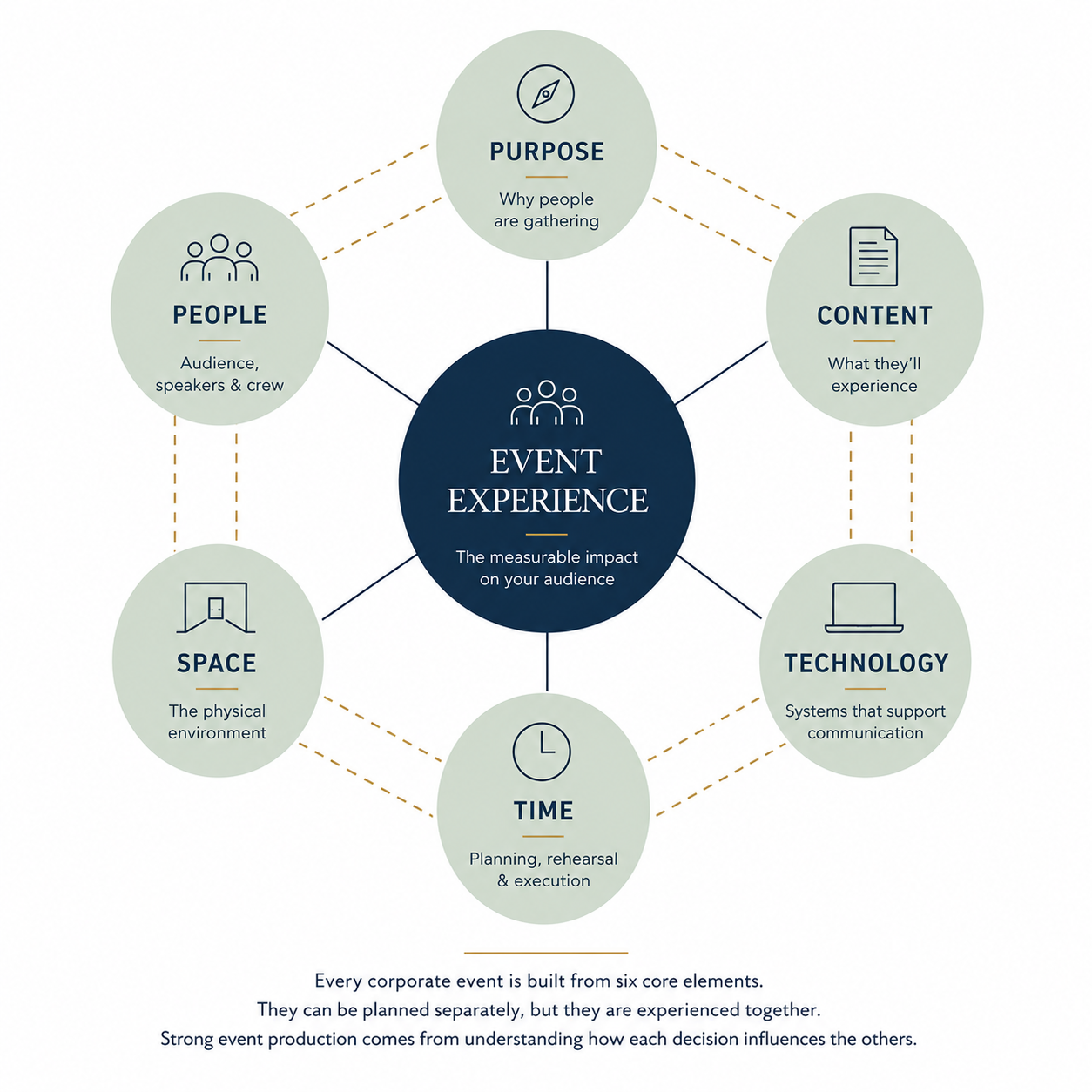
The six parts of every corporate event
Every event is built from the same six elements.
Purpose
The business reason for bringing people together.
Content
The ideas, stories, presentations, announcements, videos, and experiences the audience will receive.
People
The audience, speakers, planners, executives, crew, venue staff, and vendors responsible for the event.
Space
The room, stage, seating, sightlines, acoustics, loading access, power, internet, and backstage areas.
Technology
The systems that allow people to see, hear, present, record, and participate.
Time
The planning calendar, content deadlines, load-in, rehearsals, session timing, breaks, and strike.
On paper, these look like separate categories.
In the room, they are inseparable.
A beautiful stage can create poor sightlines. A packed agenda can eliminate the rehearsal time executives need. A video may communicate an idea perfectly, but become useless if it is delivered in the wrong format five minutes before playback.
Good conference production accounts for the connections.
The audience experiences one event.
They do not care which department owned the problem.
The production process
The exact process changes with the size and complexity of the event, but the major phases
remain consistent.
Discovery
This is where the production team learns why the event exists.
The conversation should cover the audience, business goals, venue, program, budget, brand, speakers, content, and any concerns carried over from previous events.
A good production partner will ask questions that have little to do with equipment.
What has frustrated attendees in the past? Which moment matters most to leadership? Who owns the presentations? Is the event meant to teach, celebrate, persuade, or align?
Those answers eventually become technical decisions.
This surprises people.
A technical recommendation is often the final result of a very nontechnical conversation.
The screen size may depend on how detailed the financial presentation is. The lighting design may depend on whether the room should feel celebratory or serious. The number of cameras may depend on what remote viewers need to understand.
The better the conversation, the better the equipment decisions become.
In-person pre-production
We insist on meeting in person as early as the project allows.
It is difficult to overestimate the value of getting planners, producers, and key stakeholders in the same room. An in-person meeting reveals assumptions that can survive through weeks of email and video calls.
People sketch ideas. They react to options together. A question about the stage uncovers a concern about content. A discussion about an executive presentation reveals that no one has been assigned to create it.
You can watch the event become real in people’s minds.
That matters.
Until everyone can imagine roughly the same event, they may be agreeing to completely different things without knowing it.
The cost of this meeting is small. The value often shows up everywhere else.
For the University of North Texas, early creative consulting helped the orientation team rethink how its program communicated with a new generation of students. That planning led to a series of videos and a different live experience, rather than simply adding more technology to the existing format.
Design
Once the goals are clear, the production team can design the experience and the systems required to support it.
This includes the stage, screens, audio, lighting, room layout, playback systems, cameras, staffing, and technical infrastructure.
It also includes decisions about pacing and presentation.
Will speakers use slides, interviews, demonstrations, or video? Will the audience need to see detailed data? Does the content need to work for people in the back of the ballroom? Will remote viewers receive the same program or a separate broadcast experience?
A production design is only useful when it fits the room, program, audience, and budget. The largest screen is not automatically the right screen.
The most elaborate stage is not automatically the best stage.
More production is not always better production.
The right production helps the audience know where to look, what to listen to, and why the moment matters.
Content development
This is where many conferences begin to fall behind.
Planners routinely underestimate how long it takes to gather, shape, approve, and test content. The opening video that sounded simple may require interviews, filming, editing, graphics, music, legal review, and several rounds of executive feedback.
Slides arrive from ten departments in ten different formats. Speaker biographies change. Scripts wait for approval. Someone remembers that the CEO wants to show a video, but nobody knows where the file is.
None of this is unusual.
That is the problem.
Because it happens so often, teams begin treating last-minute content as an unavoidable part of event production. It is not unavoidable. It is the predictable result of content being treated as a collection of files instead of a production process.
Content needs a schedule of its own. Assign ownership. Establish deadlines. Decide who can approve changes. Create a system for file names and versions. Give important media enough time to become good.
Relevant, well-produced media can reset the attention of a room. It can explain an idea faster than another stack of slides. It can add emotional weight that a speaker may not be able to create alone.
But rich media takes time.
The Marriott Engineering and Facilities Conference is a useful example. The event’s theme, messaging, brand identity, and content were developed as parts of the same experience. Content was captured across the country before the final conference in Orlando. The result depended on creative work beginning well before the ballroom was built.
Technical planning and logistics
The production team now turns the design into a working plan.
That includes equipment, crew, power, internet, rigging, freight, loading access, schedules, communication systems, and coordination with the venue.
The team should also identify failure points.
What happens if the primary presentation computer stops working? Is there a spare microphone ready? What happens if the internet connection fails during a stream? Who decides whether the show waits for a late executive or moves forward?
Contingency planning is not pessimism.
It is an admission that live events happen in the real world.
Computers fail. Flights are delayed. Executives change their minds. People email new presentations from the car.
The goal is not to create a world where nothing goes wrong. The goal is to keep one problem from becoming the audience’s problem.
This becomes even more important when an event moves. Five Stone’s work with Amazon included six employee development events in multiple cities over three weeks. In that environment, production design and tour logistics have to function as one system. Read the Amazon PXT Academy client story.
Load-in and testing
Load-in is when the plan meets the room. Equipment is installed, configured, connected, and tested. The crew confirms signal paths, microphone coverage, screen content, lighting positions, camera angles, playback, and communication.
Testing individual pieces is not enough.
A video file can play correctly on a laptop and still fail somewhere between playback, switching, signal distribution, and the screen.
The complete path must be tested.
The same is true for people. A presenter may know a speech perfectly and still be uncertain about where to stand, when to walk onstage, or how to advance slides.
Which brings us to rehearsal.
Rehearsal
Rehearsal is often treated as optional time for speakers to practice their remarks. It is much more than that.
A useful rehearsal tests entrances, exits, microphones, slides, video cues, timing, transitions, stage movement, and communication between the stage and control area.
Prepared speakers give the production team something to support. Unprepared speakers force the show to absorb uncertainty in real time.
One exception is worth mentioning.
Some presenters are genuinely better when they are not over-rehearsed. They need room to respond to the audience and remain present in the moment.
But relaxed is not the same as unprepared.
They should still know the purpose of the session, understand the flow, recognize their cues, and be familiar with the media supporting them.
A compelling set and excellent sound cannot rescue a session with no clear point, weak media, and a presenter seeing the final slides for the first time.
Content and preparation still win.
Showtime
During the show, the production team executes the plan and manages the changes. Speakers run long. Presentations are revised. Videos are replaced. A session that looked simple during planning suddenly includes a panelist calling in from another city.
The goal is not to prevent all change. That is impossible.
The goal is to build a team and process capable of handling change without transferring the stress to the audience or planner.
This is where preparation becomes freedom.
Because the fundamentals are settled, the team has the capacity to respond. Because everyone knows the plan, they can recognize when it is safe to depart from it.
When Get Your Teach On brought more than 4,300 educators together for its national conference, the scale left little room for uncertainty. The production supported sound, lighting, projection, video capture, and live streaming while preserving the organization's personality.
What planners should decide early
Some event decisions can remain flexible for a while. Others become expensive when delayed.
Try to establish these items early:
- The purpose of the event
- Audience size
- Venue and room
- Program format
- General session and breakout needs
- Stage and screen requirements
- Speaker count
- Streaming and recording plans
- Content ownership
- Accessibility requirements
- Budget priorities
Early decisions do not have to be perfect.
They need to be visible.
If an important decision remains open, identify who owns it and when it must be made. Uncertainty is manageable when everyone knows it exists.
Hidden uncertainty is what gets expensive.
Where the event production budget goes
A corporate AV budget usually includes more than equipment.
Major cost categories may include:
- Equipment
- Technical labor
- Production management
- Staging and scenic elements
- Creative development
- Content production
- Venue charges
- Power, rigging, and internet
- Freight and travel
- Recording and post-production
- Contingency
Here is what gets missed.
A lower equipment price does not always create a lower event cost.
If the quote excludes rehearsal labor, power, internet, rigging, freight, or the people required to operate the system, the total may look very different later.
Price matters. So does understanding what the price represents.
The least expensive time to solve a production problem is usually during a conversation.
Moving a screen on a drawing is easy. Moving it after rigging has been installed and the room is set is not.
Early planning does not remove every cost, but it gives you more control over where the money goes.
How to choose an event production company
A production partner should understand the technology. That is the starting point.
Pay attention to the questions the company asks.
Do they want to understand the audience and purpose? Can they explain their recommendations without hiding behind technical language? Will they work directly with the venue and other vendors? Who will own communication? How do they manage presentations, speakers, and last-minute changes?
Ask about the proposal as well.
What is included? What could change? Are venue costs represented? Is rehearsal labor included? What assumptions could affect the final price?
Then consider the human question.
Do you want these people beside you when the schedule slips, an executive changes the presentation, and 800 attendees are waiting outside the ballroom?
Every production company looks competent when the proposal is a PDF.
You learn who they are when something changes.
Equipment matters. Trust matters more when the doors open.
A few considerations for Dallas and Fort Worth events
DFW offers an enormous range of hotels, conference centers, corporate campuses, arenas, and unconventional event spaces.
It also covers a lot of ground.
Travel between the airport, hotel, warehouse, and venue can add meaningful time. Loading rules vary by property. Hotel contracts may include restrictions involving AV, internet, power, rigging, and labor. Outdoor events need realistic plans for heat, wind, and storms.
A local Dallas event production company can help identify these issues early. More importantly, it can help planners ask better questions before a venue agreement is finalized.
Local knowledge does not replace planning.
It makes planning more accurate.
The real measure of a well-produced event
Most attendees will never know which microphones were used. They will not know how the video reached the screen or how many backups were waiting in the control area.
They will know whether they could hear.
They will know whether the presentations held their attention.They will know whether the event respected their time. And, if the event is good enough, they may leave thinking differently than when they arrived. That is the opportunity.
For a few hours or a few days, an organization has gathered its people in the same place. It has their attention. It can clarify what matters, recognize great work, teach something useful, introduce a new direction, or remind people why their work is worth doing.
That attention is expensive to earn.
It should not be wasted.
The planner will know something else.
Backstage was quiet.
The show moved forward. The speakers felt supported. Changes were handled without drama. The planner was able to lead the event instead of troubleshooting it.
The quiet was not the absence of work.
It was evidence of it.
That is what corporate event production is supposed to create.
If you are planning a corporate event in Dallas, Fort Worth, or somewhere farther down the road, Five Stone Creative can help connect the message, content, and production from the beginning.
Tell us what the event needs to accomplish.
We can start there.