The Event Production RFP Guide
How to Get Better Proposals
Most event production RFPs begin with a document.
They should begin with a conversation.
A planner collects dates, room counts, attendance estimates, and a preliminary schedule. Procurement adds legal requirements and scoring criteria. The finished RFP is sent to several production companies.
Weeks later, a collection of proposals arrives.
The totals are different.
The equipment lists are different.
The assumptions are everywhere.
Now the planner has to compare them.
This is where many teams discover that the RFP created more confusion than clarity.
A successful event production RFP should help you compare how companies think. Most RFPs only compare how they format equipment lists.
Why traditional event production RFPs fall short
A typical RFP might describe a general session for 300 people, three breakout rooms, two days of programming, and an evening reception.
That is enough information to begin estimating equipment.
It is not enough information to design an event.
- What is the purpose of the general session?
- Is the organization announcing a major change, training employees, recognizing performance, launching a product, or bringing a distributed team together?
- How should the room feel?
- Which stakeholders have the strongest opinions?
- What disappointed people last year?
- Which moments carry the most risk?
- What matters enough to deserve more of the budget?
Without that context, every production company fills the gaps with assumptions.
One assumes the client wants an LED wall. Another proposes projection. One includes extensive pre-production. Another plans to begin working through the details onsite.
The proposals look different because the companies are pricing different events.
A generic RFP does not create a fair comparison.
It creates comparable guesses.
AI can write the document. It cannot define the event.
AI is an incredible resource for creating an RFP.
It can organize information, suggest categories, identify missing sections, improve clarity, and turn rough notes into a professional document. Used well, it can save hours.
But AI cannot decide what the essence of your event should be.
It does not know which stakeholder needs to feel heard. It cannot determine whether the opening should create urgency or confidence. It does not know that last year’s general session looked impressive but left the audience confused.
Unless you tell it.
This is where AI-generated RFPs can go wrong.
Weak source material becomes a polished generic document. The headings look right. The sentences sound professional. The actual event remains a mystery.
In our experience, vague RFPs often produce higher estimates. When production companies do not understand the scope, they either add protection for the unknowns or leave important costs out and address them later.
Neither outcome helps the planner.
AI can organize your thinking.
It cannot replace it.
Before asking any tool to write the RFP, gather the event team and answer the human questions first.
Start with a shortlist, not a mass invitation
A full event production proposal takes meaningful time to develop.
The production company may need to review the program, study venue information, design technical systems, calculate labor, request partner pricing, build a schedule, and write a scope of work.
Inviting eight or ten companies into that process does not necessarily produce a better decision.
It often creates more paperwork and less meaningful engagement.
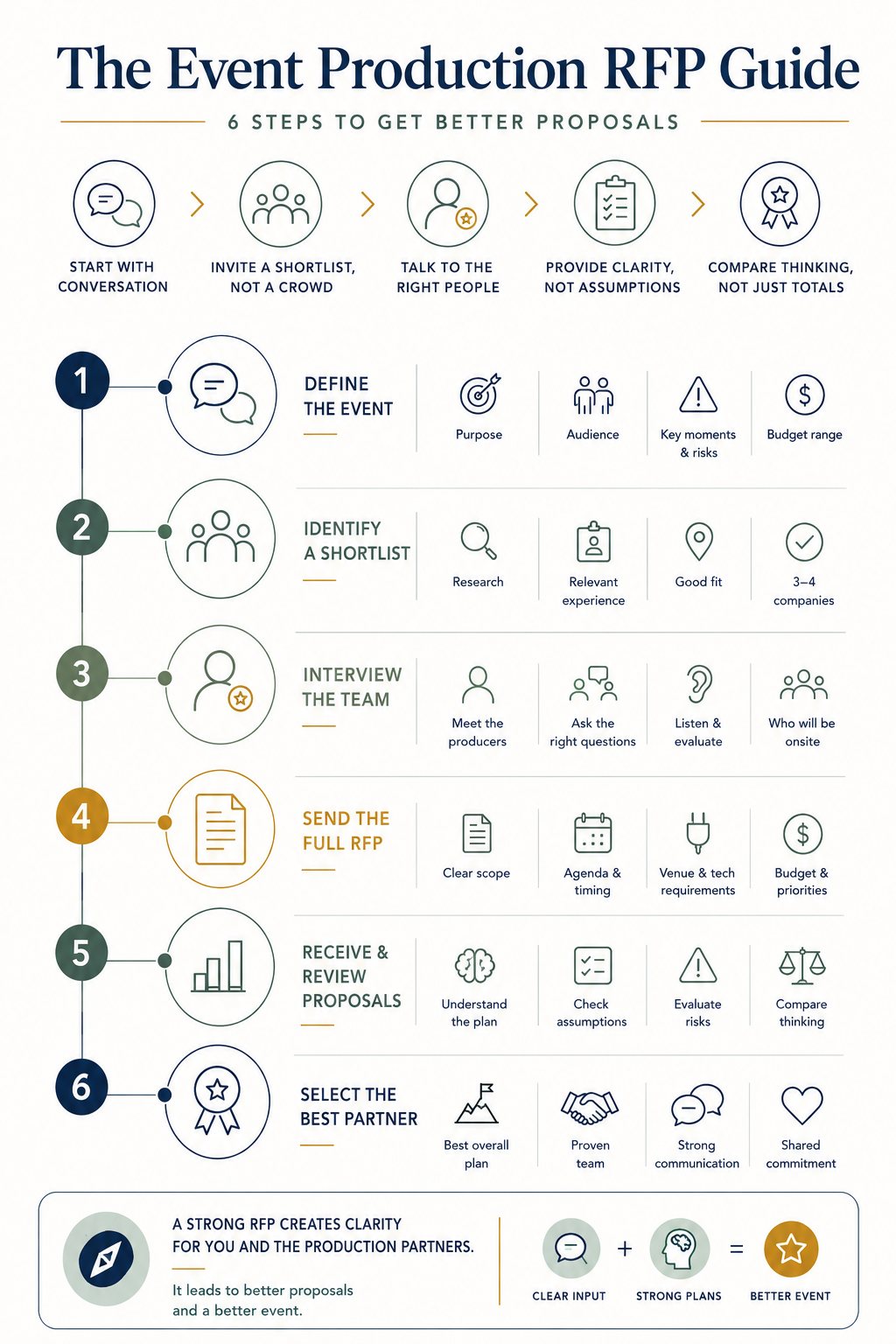
Start by identifying three or four potential partners through research, referrals, relevant experience, and industry recommendations.
Then schedule a video call with each company.
This does not need to become a month-long qualification process. A focused conversation can reveal more than a polished proposal.
After those calls, narrow the field to two companies.
Send the full RFP to those two.
The goal is not to create the largest possible competition.
It is to create the clearest possible choice.
Interview the people who may produce the show
Your first conversation should include at least one of these people:
- A producer
- A creative director
- A technical director
A meeting with only a salesperson is of limited value if that person will not be involved after the agreement is signed.
The salesperson may understand the company and communicate its capabilities well. But they may not be the person interpreting your goals, designing the production, leading the crew, or solving problems onsite.
You are not hiring a proposal.
Ask who would lead the account. Ask who would be onsite. Ask whether the people on the call are likely to remain involved through the event.
Then pay attention to how the conversation feels.
- Do they listen?
- Do they ask useful questions?
- Can they explain technical ideas plainly?
- Do they seem interested in what the event needs to accomplish, or are they waiting for an opportunity to describe their equipment?
- Do they understand the difference between a lively room and a loud one?
You will get the best show from a team that communicates well with yours.
You cannot discover that from a proposal.
Full stop.
What a useful event production RFP should include
A good RFP gives each finalist enough information to propose the same event while leaving room for each company to demonstrate its thinking.
Include the following:
Event purpose
Explain why people are gathering and what the organization wants the event to accomplish. Describe what attendees should understand, feel, or do afterward.
Audience
Include attendance, roles, familiarity with the subject, and whether the audience will participate in person, remotely, or both.
Three hundred employees attending mandatory training require a different experience than 300 customers attending a product conference.
Stakeholders
Identify the people or teams with meaningful influence over the event. This may include leadership, marketing, internal communications, learning and development, procurement, or an outside agency. Explain which decisions require executive approval.
Desired experience
Describe the tone or vibe. Should the event feel polished and formal? Energetic? Intimate? Celebratory? Cinematic? Practical and focused? These words are subjective, so provide examples when possible.
Program and session formats
Include more than session titles. Specify whether each session is expected to be:
- A keynote
- A panel
- An interview
- A product demonstration
- An awards presentation
- A performance
- A training session
- A remote contribution
- A video-driven segment
If the format is still being developed, say so and explain what support you need.
Venue information
Provide room dimensions, ceiling height, seating plans, loading information, rigging rules, power requirements, internet policies, and any exclusive services. Include the venue contract or production guidelines when permitted.
Schedule
Provide expected dates and times for:
- Room access
- Load-in
- Setup
- Testing
- Rehearsals
- Doors opening
- Show hours
- Breaks
- Strike
- Move-out
Labor cannot be estimated accurately without an operating schedule.
Content requirements
Explain what already exists and what may need to be created. This could include:
- Presentation templates
- Speaker decks
- Opening videos
- Motion graphics
- Walk-in content
- Awards graphics
- Recorded interviews
- Livestream graphics
- Recap content
Clarify whether the production partner is expected to create, edit, manage, or simply play the material.
Required deliverables
Identify what the proposal should include, such as:
- Recommended production approach
- Scope of work
- Equipment
- Crew roles and hours
- Production schedule
- Pre-production
- Creative services
- Renderings or room diagrams
- Freight and travel
- Taxes and fees
- Assumptions
- Exclusions
- Optional upgrades
Evaluation process
Tell respondents how the decision will be made. If price represents 40 percent of the score, say so. If creativity, relevant experience, communication, or team chemistry matter, explain that too. Companies produce better responses when they understand what the client is trying to evaluate.
Bad RFP versus useful RFP
Bad RFP: “Provide AV for 300 people”
Useful RFP: Explains the audience, purpose, program, and desired experience
Bad RFP: Lists room counts
Useful RFP: Describes what will happen in each room
Bad RFP: Requests an equipment list
Useful RFP: Requests a production approach and scope of work
Bad RFP: Hides venue restrictions
Useful RFP: Includes power, rigging, internet, labor, and outside vendor policies
Bad RFP: Invites ten companies
Useful RFP: Interviews three or four and invites two finalists
Bad RFP: Meets only with salespeople
Useful RFP: Includes a producer, creative director, or technical director
Bad RFP: Hides the budget
Useful RFP: Provides a real range and explains priorities
Should you disclose the event production budget?
This question makes planners nervous.
They worry that revealing the budget gives away their bargaining position. If the production company knows the available amount, will the proposal somehow rise to meet it?
The answer comes down to trust.
And trust is difficult to establish through a document exchange.
That is another reason to speak with potential partners before sending the RFP.
If the budget is being treated as a bargaining weapon, trust is already damaged.
A real budget range, paired with clear priorities, gives the production company a chance to make intelligent recommendations.
Tell them what matters most.
Perhaps audio and presentation management are nonnegotiable. Maybe the scenic design can remain simple. Perhaps recording every breakout matters more than an elaborate general session backdrop.
A good partner can use that information to save money in some areas and invest more in others.
It can also tell you when the available budget and desired scope do not match.
That may be disappointing, but it is valuable.
It is better than receiving a bottom line you love and a show you hate.
Give both finalists the same pricing exercise
If you need a reliable cost comparison, ask the two finalists to price the same detailed event.
The sample should include:
- Room layouts
- Audience size
- Program format
- Show schedule
- Load-in and strike times
- Rehearsal requirements
- Equipment expectations
- Labor positions and hours
- Content support
- Streaming or recording
- Freight and transportation
- Pre-production
- Venue-controlled costs
- Taxes and fees
Ask each company to identify its assumptions and exclusions.
Do not require the companies to design identical systems. Their different recommendations are part of what you are evaluating.
The goal is not to force matching equipment lists.
It is to give each company the same problem and see how it chooses to solve it.
A useful comparison asks two questions:
What does this cost?
Why is this the plan?
For more help interpreting the answers, see Understanding Corporate Event AV Costs: What You’re Paying For and How to Recognize Real Value.
Questions to ask during finalist interviews
Once you receive the proposals, meet with both teams.
Ask:
- Why did you recommend this approach?
- What did you consider but decide not to include?
- Where would you invest more if the budget increased?
- What would you change if the budget decreased?
- Which assumptions have the greatest effect on price?
- Who will own pre-production?
- Who will lead the team onsite?
- How will presentations and media be managed?
- How do you handle changes and change orders?
- What venue costs are not represented?
- What do you see as the greatest production risk?
- What do you still need to learn about the event?
The quality of the questions a company asks in return may be as revealing as its answers.
When to skip the RFP
Sometimes the best RFP is no RFP.
If you have a strong initial conversation with a production company, ask what it needs to create a proposal.
Often, the company can gather the necessary information during a focused 30- to 60-minute call. That can save the planner hours of building an RFP and allow the production team to ask follow-up questions in real time.
If the company understands the event, the communication feels strong, and the proposal fits the budget, it may be reasonable to move forward.
This approach will not work for every organization. Some companies, associations, and public institutions require formal competitive bidding.
But do not create a lengthy RFP simply because it feels like the professional way to buy production. Process should reduce uncertainty.
It should not create paperwork for its own sake.
The RFP is a conversation in document form
A good RFP does not tell a production company which equipment to rent.
It helps the company understand the event well enough to recommend the right production.
That requires dates, schedules, rooms, and technical details.
It also requires purpose.
It requires priorities.
It requires enough honesty for both sides to determine whether the relationship makes sense.
If you treat event production like a commodity during the RFP, you should not be surprised when you receive commodity proposals.
The document matters.
The conversation matters more.
Because the best proposal will not necessarily come from the company with the longest equipment list, the best-looking rendering, or the lowest number on the final page.
It will come from the team that understands where you are trying to go and has a credible plan for getting you there.