
Corporate Event Planning Timeline
What Should Happen and When
Event week gets most of the attention.
That is when the stage appears, the screens turn on, speakers begin rehearsing, and hundreds or thousands of attendees arrive.
But event week does not create the show.
It reveals it.
By the time the crew begins loading into the venue, most of the decisions that determine the quality of the event have already been made. Some were made intentionally. Others were made by waiting too long.
A successful event is not created during event week.
Event week reveals the quality of the decisions made months earlier.
This timeline is not a rigid formula. A leadership meeting for 200 people and a multi-day conference for 5,000 require different schedules. Organizations also make decisions at different speeds.
But time is not neutral in event production.
Every delayed decision reduces your options or transfers pressure to someone later in the process.
Six to twelve months out: Make the foundational decisions
The best time to involve your production partner is as early as possible.
Our long-standing clients often bring us into the conversation while they are still discussing themes and locations.
That early involvement allows the production team to help think through conference graphics,
custom presentation decks, video content, room design, and how the event should feel. But the biggest advantage may be financial.
Early conversations reveal which parts of the event matter most. That allows the production budget to be shaped around real priorities.
Spend less where the audience will not feel the difference.
Invest more where they will.
The goal is not to make every part of the event equally impressive. It is to create the best overall experience with the resources available.
At this stage:
- Clarify the event’s purpose
- Identify the primary audience
- Establish a preliminary budget
- Compare venues
- Engage a production partner
- Outline the program format
- Identify major general sessions and breakouts
- Discuss streaming, recording, and content needs
- Review venue restrictions
- Ask about outside production companies
- Negotiate power, rigging, internet, and labor terms
This is also the time to address hotel AV. Clients sometimes agree to minimum spending requirements before realizing what the
agreement contains. By the time they receive the hotel AV proposal, the venue contract has been signed, and the opportunity to negotiate has largely passed.
A third-party production company may still be able to provide the event. But the client’s required hotel spending may now be redirected toward power, rigging, internet, or other venue-controlled services.
Those costs might have been negotiable while venues were still competing for the event.
An early decision can be inexpensive.
The same decision made later can become very expensive.
Four to six months out: Design the experience
With the venue, goals, and preliminary budget established, the production team can begin designing the event.
This is when ideas start becoming rooms, stages, screens, systems, and schedules.
Key decisions may include:
- Room layouts
- Stage and scenic concepts
- Projection or LED displays
- Audio design
- Lighting design
- Camera positions
- Recording requirements
- Livestreaming
- Audience interaction
- Accessibility
- Presentation formats
- Branding and graphics
- Breakout production
The design should begin with the event’s purpose, not a collection of equipment.
Does the audience need to see detailed financial information? Will presenters move around the stage? Is the event primarily for the people in the room, or does the remote audience matter equally? Will content be captured for later use?
These answers affect the technical plan. This is also a good time to develop the agenda beyond session titles. A production team needs to know whether a session is a speech, interview, panel, demonstration, performance, orvideo-driven presentation.
“Leadership update” does not tell the crew much.
“Twenty-minute executive presentation followed by a moderated conversation with three remote participants” does.
The more clearly the format is defined, the more accurately the event can be designed and priced.
Two to four months out: Build the program and content
This is when the event begins developing a voice.
Speakers are confirmed. Themes become graphics. Session ideas become presentations. Videos move from wish lists into production.
Clients should be realistic about content timelines.
There is almost no such thing as beginning too early. At the same time, important messaging often depends on senior executives with crowded schedules and evolving priorities.
For major videos, graphics, and presentation systems, beginning two to three months before the event is a healthy target.
Does content sometimes begin much later?
Absolutely.
We have produced excellent work on short timelines. It is part of the business.
But speed removes options. It reduces the time available for creative exploration, executive
feedback, revisions, and approval.
A compressed timeline does not make great content impossible.
It makes every decision matter more.
During this phase:
- Confirm speakers
- Define session formats
- Establish presentation expectations
- Begin video production
- Develop graphics and motion content
- Select walk-in and walk-up music
- Plan session openings and transitions
- Identify executive support needs
- Reserve rehearsal time
- Develop the show flow
- Refine the production scope and budget
For the Marriott Engineering and Facilities Conference, Five Stone helped develop the event’s theme, messaging, visual identity, and content before producing the conference itself. Content was captured across the country and shaped into a cohesive experience. That work could not have begun during event week.
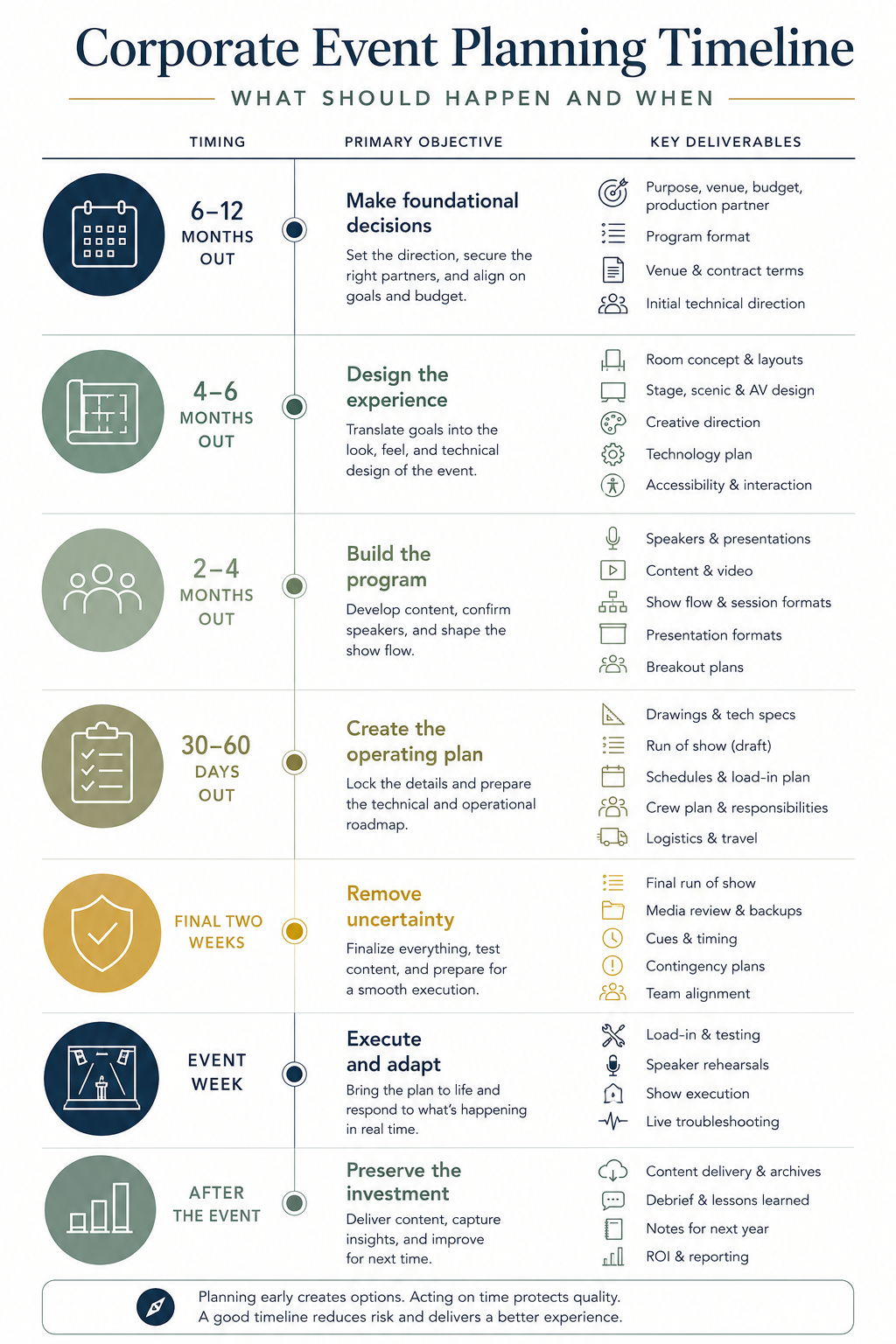
Thirty to sixty days out: Create the operating plan
At this point, creative ideas need to become specific instructions.
The production team should finalize:
- Room layouts
- Technical drawings
- Equipment plans
- Crew requirements
- Load-in schedules
- Rehearsal schedules
- Internet requirements
- Electrical requirements
- Rigging plans
- Presentation workflows
- Recording and streaming details
- Venue coordination
- Speaker movements
- Backstage requirements
This is also when presentation deadlines should be established.
Will speakers meet them?
Probably not.
Presentation deck deadlines may be the most ignored dates in corporate event planning.
Still, the deadlines matter. They create time to identify unusual fonts, missing videos, unsupported file formats, incorrect aspect ratios, and presentations designed for screens that do not exist.
Set a deadline.
Communicate it clearly.
Then create a plan for the files that will arrive after it.
Deadlines should reflect the ideal.
Production plans should reflect reality.
The final two weeks: Remove uncertainty
The final two weeks are when the event’s many parts become one show.
Production meetings become more detailed. Presentation files begin arriving. Cues are confirmed. Speakers receive instructions. Media is reviewed and tested.
Most importantly, the run of show should be finalized.
A run of show is much more than a schedule stating that the CEO speaks at 11:00 and the CMO
speaks at 3:00.
It should include every significant thing the audience will see and hear:
- Doors-open timing
- Lighting looks
- Walk-in music
- Announcements
- Speaker entrances
- Walk-up music
- Presentation file names
- Video cues
- Microphone requirements
- Stage movements
- Session timing
- Transitions
- Breaks
- Audience interaction
- Closing moments
The run of show is the shared operating document for the production.
An unfinished run of show is not a rough version of the show.
It is evidence that the show itself is still unfinished. Drafts are part of the process. But before load-in, the production team needs an agreed plan with clear ownership of any remaining questions.
Otherwise, everyone enters the room carrying a different version of the event.
- During the final two weeks:
- Finalize the run of show
- Review presentations
- Confirm media file names
- Check video formats
- Verify speaker requirements
- Confirm stage movements
- Review executive rehearsals
- Conduct production meetings
- Confirm crew schedules
- Prepare backups
- Review contingency plans
- Distribute final contact information
- Most production problems do not begin on show day.
- They simply become impossible to ignore.
Event week: Execute, rehearse, and adapt
Event week begins with load-in.
The crew installs the stage, audio, video, lighting, communications, and other technical systems. Every part is tested individually and as part of the complete system.
Then rehearsals begin.
If you do not know the CEO’s rehearsal style, schedule 90 minutes.
That allows roughly an hour for rehearsal and 30 minutes for the executive to be running late. Some CEOs want to stand onstage, locate the confidence monitors, click through a few slides, and leave after five minutes.
Others want to run the entire presentation two or three times.
If you do not know which kind of executive you are working with, err on the side of more time.
One more thing. Do not make the CEO the first rehearsal.
Give the production team an opportunity to test the full rehearsal process with someone who carries a little less organizational gravity. Work through slide control, confidence monitors, lighting, microphones, entrances, and timing before the highest-stakes presenter walks into the room.
The CEO should rehearse the presentation.
The production team should not be rehearsing the system on the CEO.
Event week usually includes:
- Load-in
- System configuration
- Technical testing
- Content review
- Speaker rehearsals
- Crew briefings
- Venue coordination
- Final presentation updates
- Show execution
- Daily production meetings
- Adjustments for the following day
Presentation decks will continue to change.
That is not ideal.
It is realistic.
A good production company wants the presentations early, builds a disciplined process for
managing them, and remains prepared for a new version to arrive on show day.
Flexibility is not the absence of a plan.
It is a plan designed to absorb change.
When the planning has been strong, event week feels different.
Backstage is quiet.
People communicate clearly. Changes are handled without drama. The planner can focus on guests, speakers, and leadership instead of tracking down files or troubleshooting equipment.
That calm was created months earlier.
After the event: Preserve the investment
The event ends.
The learning should not.
Your production company should request a follow-up conversation within a week or two. If it does not, and you expect to use the company again, ask for one.
Discuss the good, the bad, and the ugly while the experience is still fresh.
What worked better than expected?
Where did communication break down?
Which content connected with the audience?
Which sessions ran long?
What should begin earlier next time?
What should never be purchased again?
A candid conversation after the event may be the single best way to improve the next one.
- Post-event work may also include:
- Delivering recordings
- Editing session content
- Creating recap videos
- Organizing photography
- Archiving presentation files
- Preserving graphics and show media
- Saving technical drawings
- Updating production notes
- Documenting venue information
- Reconciling final costs
Memory has a short half-life after a major event.
People return to their regular work. Details blur. Small frustrations are forgotten until they happen again next year.
Write the lessons down.
The calendar is part of the production
A timeline cannot guarantee that every presentation will arrive early.
It cannot prevent an executive from changing the message or a venue from presenting an unexpected restriction.
That is not its purpose.
The purpose of a timeline is to make the important decisions while useful options still exist.
Early planning creates choices.
Late planning creates consequences.
A successful event is not created during event week.
Event week reveals the work that came before it.