The Event Creative Guide
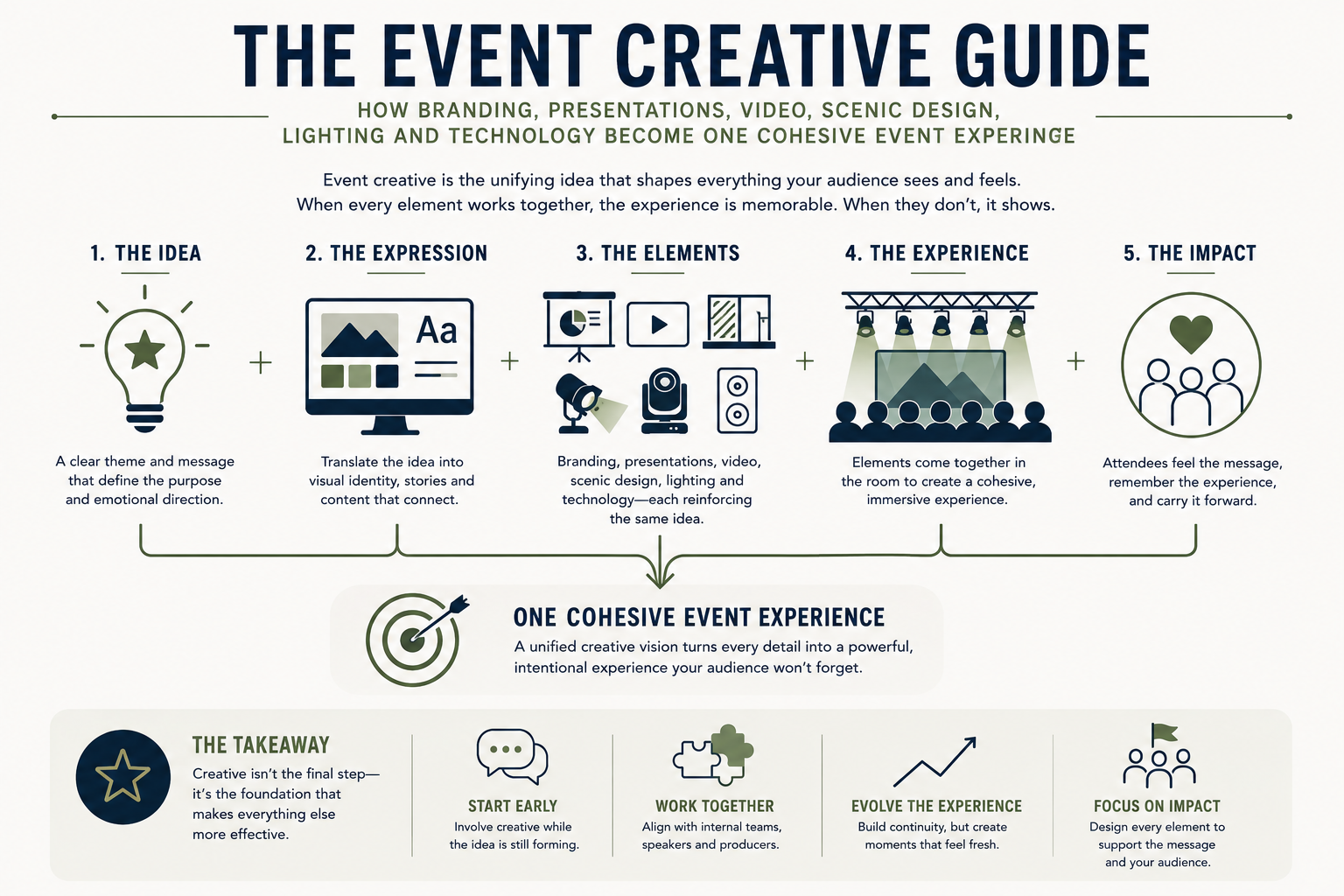
How branding, presentations, video, scenic design, lighting and technology become one cohesive event experience
Every event has a look and feel, whether someone designed it intentionally or not.
Event creative is the visual and emotional system that shapes that experience. It includes the event theme, branding, colors, logos, presentation decks, videos, motion graphics, scenic design, lighting and nearly everything else the audience sees and hears.
These are not separate creative assignments.
They are different expressions of the same idea.
When those elements work together, attendees may not be able to explain exactly why the event feels important. They simply know that it does.
When they do not work together, even an expensive production can feel generic.
Event creative is not decoration added after production is planned. It is the idea that informs the production.
The forgotten part of event planning
Creative often becomes the forgotten element of an event.
The venue is contracted. The agenda begins to take shape. Speakers are invited. AV proposals are requested. Eventually, someone realizes the conference needs a logo, presentation template and opening video.
By then, many of the decisions that could have supported the creative direction have already been made.
That is unfortunate because creative may be the single biggest factor in how attendees perceive the event. It can also help an organization get more value from almost every part of the production budget.
An LED wall is equipment.
What appears on it is communication.
Lighting fixtures are equipment.
How their colors and movement support the message is creative.
The room, screens and speakers may all be excellent. Without a unifying creative idea, the audience experiences them as separate pieces.
Why internal design teams are not always the answer
Many organizations have talented internal designers. It is understandable to assume those teams can create the event assets.
Sometimes they can.
The challenge is often capacity. Internal teams already have campaigns, presentations, websites and everyday business needs competing for their time. Event work arrives with large file formats, aggressive deadlines and dozens of interconnected deliverables.
There is also a question of ownership.
A designer who is not a stakeholder in the event may create exactly what was requested without pushing the idea further. They may not be in the conversations about the audience, speakers, production technology or emotional arc of the program.
That is not a criticism of internal teams. It is a reason to involve them differently.
The event creative team can work alongside the organization’s designers, understand the established brand and expand it into an experience. Internal designers protect the company identity. Event creatives translate that identity into a room, a screen and a live moment.
The work may begin with a logo.
It should never end there.
Creative should begin early
The creative process should start quickly after the event’s foundational information is established.
Once dates and a venue are selected, creative should be part of the conversation.
Ideally, the creative team is involved while the conference theme is still being developed. That surprises some clients. They assume the theme belongs to leadership or marketing and the creative team’s job is to make it look good afterward.
But a slight change in how a theme is expressed can create far greater potential for design, video, presentations and audience engagement.
A phrase may sound appropriate in a meeting but offer very little visually. Another version of the same idea may suggest motion, progression, contrast, transformation or a story that can develop over several days.
The creative team is not there to take ownership away from stakeholders.
It is there to help the idea travel farther.
For a broader look at when production and content decisions should happen, see our Corporate Event Planning Timeline.
A strong theme needs somewhere to go
A conference theme should do more than sit beneath the event logo.
It should create possibilities.
Can it introduce the program?
Can it evolve across multiple days?
Can speakers connect their messages to it?
Can it inform videos, graphics and transitions?
Can the room itself express the idea?
A clever phrase with nowhere to go is not much of a theme.
The best themes create a framework. They give the organization a way to connect individual sessions to a larger journey without forcing every speaker to repeat the same words.
This is particularly important during a multi-day conference. The initial “wow” of the room fades quickly when attendees see the same colors, graphics and visual treatment for three days.
The experience needs continuity.
It also needs evolution.
Give each day a distinct identity
For the Marriott Americas Engineering and Facilities Conference, we developed a conference identity using three principal colors.
Each day used a different color to highlight that day’s subtheme. The LED content, lighting, presentation design and other visual elements changed with it.
Attendees entered what felt like a new room and a new chapter each morning. The experience evolved, but every day remained connected to the main conference theme.
That distinction matters.
A three-day conference should not feel like the same day repeated three times.
The event may begin by introducing a challenge, move toward understanding and end with action. Creative can make that progression visible before anyone explains it.
Color is only one tool. Motion, music, video, language, scenic details and presentation design can all help the audience feel where they are in the story.
The room does not need to be rebuilt every morning.
It needs to mean something different.
How closely should the event follow the company brand?
This answer may surprise some people:
As little as possible.
Of course the company’s brand must be represented. Logos, colors, typography and standards matter. The event should still feel credible and connected to the organization.
But most attendees remember who they work for.
They know which conference they are attending.
An event is an opportunity to communicate something new. It should move people from point A to point B, then perhaps from B to C and beyond.
If every creative decision is limited to the company’s everyday design system, the conference may feel like an enlarged version of an internal PowerPoint.
There is nothing wrong with brand consistency.
There is a problem when consistency becomes the reason nobody explores a better idea.
The strongest event identities feel related to the company without being trapped by its daily communication. They create enough distinction to signal that this moment deserves a different level of attention.
The company brand establishes who is speaking.
The event brand helps communicate what needs to be heard.
The expensive screen is not the content
It drives us crazy to see a beautiful LED wall displaying a company logo next to a generic PowerPoint presentation.
The LED wall is the expensive part.
Designing content that brings it to life is usually a fraction of that investment.
An ultrawide display can create an immersive visual environment. It can support a speaker with imagery, data, movement and context. Multiple screens can create hierarchy and direct attention.
But none of that happens if the creative team designs a standard 16:9 slide deck and hopes the production team can make it fit.
Technology can make an idea larger.
It cannot make the idea better.
Before selecting screen sizes or scenic elements, the creative and technical teams should discuss how the environment will be used. Before creating graphics, the designers need exact pixel dimensions, safe areas, sightlines and presentation requirements.
Creative and production have to work hand in hand.
Otherwise, one team creates possibilities the other cannot execute.
No single element creates the experience
Which creative element matters most?
The opening video?
Presentation decks?
Scenic design?
Lighting?
Music?
Motion graphics?
None of the above.
All of the above.
The audience experiences the accumulated effect of everything working together.
Attendees walk into the room on the first morning. They see the environment, hear the music and notice the lighting. The first video begins. The keynote speaker walks onstage. The presentation looks like it belongs in the room.
They cannot point to every individual decision.
They simply understand:
This message is important.
That feeling is the goal.
An outstanding opening video cannot carry three days of generic presentations. Beautiful scenic design cannot fix an event with no visual consistency. A polished deck cannot create energy if every transition feels accidental.
Good creative rarely asks one element to do all the work.
Presentation decks are part of the event design
Everyone has seen a terrible corporate presentation.
Most people have created one too.
That is exactly why attendees expect something better at an important event.
Presentation decks occupy some of the largest and most visible surfaces in the room. They may remain onscreen for hours. Yet they are often treated as documents speakers create individually instead of as part of the event experience.
The result is predictable:
Different fonts
Conflicting colors
Inconsistent title slides
Tiny text
Unreadable charts
Low-resolution images
Logos placed everywhere
Slides designed for laptops rather than large screens
A template helps, but a template alone is not presentation management.
Speakers need clear expectations, deadlines and support. Some decks may only require formatting. Others need significant design help. Key presentations may need to be rebuilt around the speaker’s story.
The degree of control depends on the event, but the audience should not feel as though every speaker wandered in from a different conference.
A cohesive deck system allows individual voices to remain distinct while making the entire program feel intentional.
Video should move the event forward
Event videos can open the conference, introduce a theme, recognize achievements, explain ideas, add humor and give speakers an entrance worthy of the moment.
They should not exist simply because the agenda says “play video.”
Every video needs a job.
An opening video may establish the stakes. A customer story can make an abstract strategy personal. A transition video can reset the room after lunch. A closing piece can show the audience what comes next.
One of our favorite creative options is an animated cartoon speaker introduction.
CEOs love them.
They love seeing themselves brought to life in a surprising way, and they especially enjoy using them to impress an important guest keynote. They are memorable, relatively inexpensive and far more interesting than placing a speaker’s biography on the screen while someone reads it aloud.
That is only one example of the value an experienced event creative team brings. Good teams develop a collection of ideas over time, then adapt the right one to the audience, speaker and purpose.
Creativity does not always mean spending more.
Sometimes it means knowing a better way to use what is already available.
Creative direction can maximize the production budget
Event creative is sometimes treated as an additional cost.
In reality, it can increase the value of money already being spent.
If the event has LED walls, creative ensures those walls are used fully. If the production includes lighting, a defined color system helps the lighting tell the same story as the screens. If videos are already planned, a shared visual language makes them feel connected to the presentations and room.
Strong creative can also reveal where the event does not need to spend.
A thoughtful projection design may create more impact than an unnecessarily large LED installation. One adaptable scenic system may support several different looks. A strong motion package can transform transitions without adding physical elements to the stage.
More equipment creates more capability.
Creative determines whether that capability matters.
This is why creative should be discussed during pre-production rather than added after the technical proposal is approved. For more on how these decisions affect the overall scope, see Understanding Corporate Event AV Costs.
Stakeholders should be first and last
The key stakeholder needs to be involved at the beginning of the creative process and again when the direction is ready for approval.
The detailed work can happen in the middle.
Senior leaders do not need to attend every design meeting or review every version of every graphic. They do need to establish what the event must accomplish, respond to the major creative direction and confirm that the finished system supports the message.
Problems begin when the creative team receives secondhand instructions, completes weeks of work and then discovers that the true decision-maker imagined something entirely different.
That is frustrating for everyone and expensive for the client.
Bring the key stakeholder in first to establish direction.
Let the creative and event teams do the work.
Bring the stakeholder back to approve the destination.
Event creative and production should be one conversation
Creative concepts have to survive contact with the room.
The stage has dimensions. Screens have resolutions. Lighting positions are limited by rigging. Cameras require sightlines.
Presenters need confidence monitors. Livestream viewers may see a completely different composition from the audience onsite.
A design may look beautiful on a laptop and fail completely when stretched across a three-wall LED environment.
Likewise, an advanced technical system has very little value if the content was never designed to take advantage of it.
This is one reason Five Stone approaches corporate event production as a connected system. Creative directors, producers, designers and technicians need to understand the same goal.
The audience does not experience creative and production as separate departments.
Neither should the planning team.
From orientation to an evolving experience
The University of North Texas brought us into the process before there were developed ideas or established production budgets.
The request was wonderfully simple:
Help us make student orientation interesting to students.
That gave the creative, video, design and event production teams the opportunity to work together from the beginning. Instead of placing isolated creative elements onto a predetermined program, we could consider the entire experience.
The result was a cohesive orientation program built for an audience with high expectations and plenty of competition for its attention.
The partnership continues, which may be the most important part of the story. Each year, the program can be expanded, edited and reimagined. Creative becomes a system that grows with the event rather than a collection of assets rebuilt from scratch.
A good event identity should solve this year’s challenge.
A great one creates possibilities for next year.
Questions to ask an event creative partner
Before selecting a creative partner, ask:
How will you learn what this event needs to accomplish?
Can you help shape the theme before design begins?
How will the event identity relate to our established brand?
How will the creative direction evolve across multiple days?
Who will design and manage presentation templates?
How will video, graphics, scenic and lighting work together?
Does your team understand the technical environment in which the creative will appear?
What do you need from our key stakeholders, and when?
Can the creative system be updated or expanded for future events?
Can you show us an event where the individual elements clearly belonged to one larger idea?
Do not only review isolated logos, videos or stage renderings.
Look for evidence that the team can create a complete experience.
The real purpose of event creative
Attendees may never compliment the presentation template.
They may not notice that the lighting color matches the motion graphics or that the opening video introduced an idea repeated during the closing session.
They do not need to.
The goal is not to make the audience admire every design decision. The goal is to use those decisions to focus attention, clarify the message and make the experience feel important.
Five Stone Creative provides event creative and design for conferences, meetings and brand experiences in Dallas-Fort Worth and nationwide. From event themes, branding and presentation decks to video, motion graphics, scenic design and lighting, we connect every creative element to one clear idea, then work alongside the production team to bring it to life.
Event creative is not a logo.
It is not a deck.
It is not a video, stage or lighting look.
It is the idea connecting all of them.
When that idea is strong, every part of the event works harder.
And the audience feels the difference.