
Understanding Corporate
Video Production Costs
What Drives the Budget, Where to Spend, and How to Get More Value
Corporate video production is expensive.
At least, that is what many companies assume before the first conversation begins.
And it can be expensive.
If you are producing a national commercial with celebrity talent, elaborate sets, a large agency, and a Super Bowl media buy, the budget will reflect it. But most corporate video projects are not Super Bowl commercials.
They are training programs, product guides, customer stories, recruiting films, executive messages, event videos, and brand content. They need to look professional, communicate clearly, and hold the attention of a specific audience.
They do not necessarily need a giant studio, a forty-person crew, and an agency infrastructure designed for global advertising campaigns.
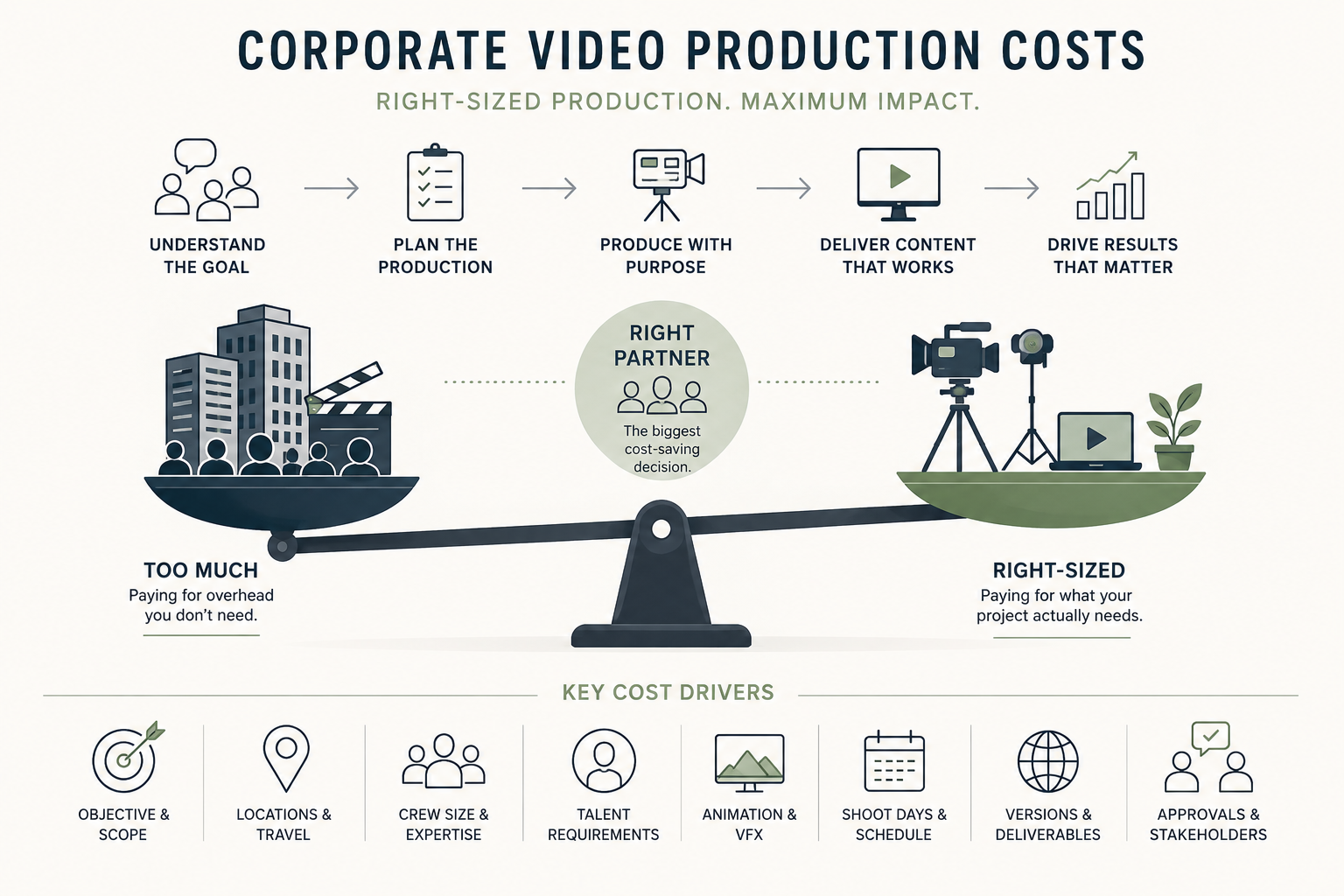
The biggest cost-saving decision is often not what equipment to remove.
It is choosing the right production partner for the job.
There is a large and important space between a major creative agency and “a guy with a camera.” Small and mid-sized production companies can offer experienced producers, directors, technicians, writers, and editors without carrying the overhead of a large studio or agency.
The question is not whether the largest company can produce excellent work.
It probably can.
The question is whether your project needs everything you will be paying that company to maintain.
Right-sized production is not cheap production.
It is paying for what the project actually needs.
Why there is no standard price for a corporate video
Companies often ask what a video costs before the production team knows what the video is.
That is understandable. Someone needs to establish a budget, compare options, or determine whether the idea is realistic.
But “a corporate video” is not a useful unit of measurement.
A two-minute executive message filmed in one office is different from a two-minute training video filmed across several locations. A customer story built around one interview is different from a product film requiring actors, wardrobe, animation, and controlled demonstrations.
The finished videos may have the same runtime.
They may require completely different productions.
Video costs are influenced by questions such as:
- What does the video need to accomplish?
- How many deliverables are required?
- How many production days will be needed?
- How large should the crew be?
- Where will filming happen?
- Will the crew need to travel?
- Does the project require professional talent?
- Will there be animation or visual effects?
- How much scripting and creative development is needed?
- How many stakeholders will participate in approvals?
- How many versions, formats, or languages are required?
Until those questions have answers, a production company is not really pricing a project.
It is pricing its assumptions.
That is why two proposals for “the same video” can look dramatically different. The companies may not be imagining the same production at all.
The right partner is the biggest cost-saving decision
It is tempting to believe that production costs are mostly determined by cameras, lights, and editing software.
They are not.
Equipment has become more affordable and streamlined. Professional cameras are smaller. Lighting is more efficient. Editing systems that once required expensive facilities can now operate almost anywhere.
The tools have become easier to access.
Experienced people have not become less important.
Labor and travel remain two of the largest cost drivers because the quality of a production depends on getting the right people to the right place with enough time to do the job well.
This is where choosing the right partner matters.
A large agency may bring strategists, account executives, creative directors, producers, directors, and several layers of management into a project. That structure may be appropriate for a national campaign with extensive brand research, media placement, and dozens of deliverables.
It may be unnecessary for a focused training series or product guide.
A freelancer may offer a lower rate, but one person may also be responsible for producing, directing, filming, recording audio, lighting, managing the client, and editing. That can work for simple projects. It can also leave important responsibilities uncovered.
A right-sized creative partner builds the team around the project.
Not around its own overhead.
Understand the production before comparing the price
A production company should demonstrate that it understands what you need before it begins writing a proposal.
That requires time.
The company should ask about the audience, objective, message, distribution plan, stakeholders, locations, schedule, talent, and approval process. It should understand what the client wants to manage internally and what the production team is expected to own.
Without those conversations, it becomes difficult to know what the proposal represents.
A low estimate may assume the client is writing the script, securing locations, finding talent, managing schedules, and providing finished graphics.
A higher estimate may include all of those responsibilities.
The totals are different because the jobs are different.
The more time you give a production company before it creates the proposal, the more accurately it can allocate the budget.
Saving money begins before the quote.
How a corporate video budget is usually organized
A clear video production proposal should divide the project into understandable categories.
The exact format will vary, but most corporate video budgets include some combination of:
- Pre-production
- Production
- Talent
- Expenses and travel
- Post-production
- Final deliverables
These categories matter because they help the client understand what work is being performed, not simply what equipment is being rented.
Check out our Complete Guide to Video Production for more on this process.
Pre-production
Pre-production is everything required to understand, design, and plan the project before filming begins.
It may include:
- Discovery meetings
- Creative development
- Internal production meetings
- Research
- Scripting
- Pre-interviews
- Storyboards
- Shot lists
- Location scouting
- Site visits
- Production schedules
- Crew planning
- Talent coordination
- Wardrobe and props
- Travel planning
- Client and legal review
This is the first place clients are tempted to save.
It is usually the last place we recommend cutting.
Spend money on pre-production. Full stop.
The more the production team plans with you before the shoot, the better the final product is likely to be. Pre-production gives the team time to understand the message, anticipate problems, identify opportunities, and arrive ready to create rather than discover the assignment while the clock is running.
A production day is an expensive place to have the first real creative conversation.
Moving an interview before the crew travels is easy. Discovering onsite that the location is unusable is not. Revising a script before filming may take an hour. Realizing during editing that the central idea was never captured may require another production day.
Pre-production is not administrative overhead.
It is where expensive mistakes are still inexpensive.
Production
Production is the filming itself.
The proposal should normally explain:
- Number of production days
- Expected crew
- Locations
- General production approach
- Major equipment requirements
- Travel expectations
- What the client must provide
- What the production company will manage
Video Production is usually quoted in full days.
Clients sometimes ask for a half-day because the interview or demonstration may only take a few hours. That request makes sense from the client’s perspective. It is often unrealistic from the production company’s perspective.
A crew cannot reliably film for another client in the morning, tear down, travel, prepare your location, and begin your production that afternoon.
And do you really want them to?
The hours spent filming are only part of the production day. Equipment must be prepared, transported, unloaded, built, tested, adjusted, packed, and returned. The crew may need to scout the location, protect the room from unwanted sound, move furniture, manage safety requirements, and restore the space afterward.
A half-day may describe the time a client expects to be on camera.
It does not necessarily describe the work required to produce it.
Labor
Labor is one of the most important parts of the production budget.
The crew may include:
- Producer
- Director
- Director of photography
- Camera operators
- Audio technician
- Gaffer or lighting technician
- Production assistants
- Hair and makeup
- Wardrobe
- Drone operator
- Teleprompter operator
- Data manager
- Editor
- Motion graphics designer
Not every project needs every role.
That is the point of right-sizing the production.
A simple executive interview may require a small, experienced crew. A product demonstration with several cameras, professional talent, complicated lighting, and precise continuity may require more people.
The goal is not to put the largest possible crew onsite.
It is to make sure every important responsibility belongs to someone qualified to perform it. You are not paying for a collection of job titles.
You are paying for the production to keep moving while the creative and technical details are handled correctly.
Equipment
Equipment matters, but it is one of the least useful ways for most clients to compare proposals.
A proposal may list camera bodies, lenses, lighting fixtures, audio equipment, monitors, support systems, and data storage. Unless you work in production, that list may not tell you much about the final result.
A more useful approach is to ask for examples.
Show the production company work similar to what you want to create. Ask whether the proposed budget and approach are designed to produce that level of quality.
The camera model is less important than whether the team knows how to light the scene, capture clean audio, compose the image, direct the subject, and recognize the moments the edit will need.
Equipment has become more affordable.
Judgment has not.
A great camera in the wrong hands creates a very detailed record of a bad decision.
Travel and locations
Travel can become a significant part of a video production budget.
It may include:
- Airfare
- Hotels
- Ground transportation
- Mileage
- Equipment transportation
- Baggage or freight
- Meals
- Travel days
- Location permits
The obvious way to reduce travel is to hire a crew near the filming location.
Sometimes that works.
But continuity matters when a project involves several locations or a long-term content series. A consistent core team may understand the creative direction, interview process, visual language, and client expectations well enough to justify the travel.
The goal is not always to eliminate travel.
It is to decide where consistency matters and where local resources can be used effectively.
Projects such as Five Stone’s work with Royal Caribbean International required filming aboard working ships at sea. The locations were not incidental to the story. They were where the work happened.
That kind of field production requires travel and logistical planning, but it also gives the audience something a studio cannot easily recreate - reality.
Shoot on location when the location supports the story
Studio production is not cheap.
A studio may involve facility rental, set construction, furniture, scenic elements, additional lighting, crew time, load-in, and strike. If the concept requires a controlled environment, a large set, special effects, or complete visual consistency, that expense may be justified.
But many corporate projects do not need it.
Filming at the company’s office, facility, hotel, restaurant, factory, or active work environment often saves money and creates a more credible video.
The location already exists.
The people belong there.
The background contains real information.
In a world of synthetic images and increasingly polished artificial content, real environments have value.
They look real because they are real.
That does not mean every workplace is ready for filming. Locations may have sound problems, limited space, poor lighting, security restrictions, or operational conflicts. A site visit helps the production team determine what is usable and what needs to be adjusted.
The point is not that studios are bad.
It is that you should not pay to build a reality you already have access to.
Our work with True Food Kitchen is a good example. The project was not simply about filming food beautifully. Video and photography were part of a larger effort to strengthen culinary standards, team culture and the guest experience. Working in the brand’s real environment gave the content credibility while allowing one production effort to serve several communication goals.
Talent
Professional talent can increase the budget, but it can also save the project.
Companies sometimes assume they have two options:
- Hire an expensive actor.
- Ask an employee to perform.
There are more possibilities than that.
A production partner may have access to local talent agencies, independent actors, presenters, voiceover artists, subject-matter experts, and performers who fit different budget levels.
Always ask how the production company approaches talent.
Do not assume you need to source it yourself. Do not assume professional talent is automatically unaffordable. And do not assume an employee will be convincing simply because they know the information.
Some employees are excellent on camera.
Others become visibly uncomfortable when asked to perform a script under lights while twelve coworkers watch from behind a monitor.
Using the wrong person can cost more than hiring the right one. The crew spends additional time on repeated takes. The edit becomes more difficult. The final video may still feel forced.
Talent is not only a line item.
It is part of whether the audience believes what it is seeing.
Post-production
Post-production is where the footage becomes the final video.
It may include:
- Editing
- Music
- Sound design
- Audio mixing
- Color correction
- Titles
- Captions
- Motion graphics
- Animation
- Voiceover
- Stock footage
- Review exports
- Revisions
- Final mastering
- Alternate versions
Post-production can be difficult to estimate because the amount of work depends heavily on the creative approach.
A straightforward interview edit with supporting footage is different from a video built around custom animation, detailed product visualization, or extensive visual effects.
This is where scope matters.
The proposal should describe the expected deliverables, approximate finished runtimes, included graphics, level of animation, number of review rounds, and alternate versions.
For editing and animation, pricing tied to finished deliverables can sometimes be more useful than a vague estimate of hours. A clear scope helps the client understand what is being created and gives the production company a defined target.
That does not mean every minute of video costs the same.
A finished minute of a simple interview is not equivalent to a finished minute of custom animation.
But defined deliverables are easier to evaluate than an unexplained pool of post-production time.
Animation and other additions
Animation can be extremely effective.
It can explain a process that cannot be filmed, simplify complicated information, visualize data, demonstrate an internal system, or give a video a distinctive visual identity.
It can also add substantial time and cost.
The same is true for professional talent, custom music, multiple locations, additional versions, translation, visual effects, and extensive graphics.
These elements should not be avoided simply because they cost more.
They should be connected to a purpose.
The useful question is not, “Can we remove animation?”
It is, “What is the animation helping the audience understand?”
If it carries information the camera cannot, it may be one of the most valuable investments in the project.
If it is there because someone thought the video needed more movement, there may be a simpler answer.
What makes a video project more expensive after it begins?
Some costs are predictable.
Others are created by decisions made after the scope has been established.
Common examples include:
- Adding animation that was not part of the original concept
- Adding paid talent
- Changing locations
- Expanding the number of production days
- Introducing new stakeholders late
- Rewriting the message after filming
- Requesting additional formats or versions
- Adding languages or captions
- Changing the intended audience
- Replacing approved music or graphics
- Requesting a reshoot
- Extending the revision process
Change is normal.
The problem is not that a project changes. The problem is when the team pretends the change has no effect on cost, schedule, or previously completed work.
A new idea may be worth pursuing.
It should still be treated as a new decision.
Revision rounds and stakeholder approvals
A proposal should explain how many rounds of revisions are included and what constitutes a round.
This protects both the client and the production company.
The client knows what to expect. The production team can reserve the appropriate time. Everyone has an incentive to collect and consolidate feedback before it reaches the editor.
The most expensive feedback process is usually not the one with the most opinions.
It is the one where the most important opinion arrives last.
Whenever possible, major stakeholders should participate in the first review. Watching the initial edit together allows the group to discuss the concept, tone, structure, and message before several rounds are spent refining details.
Feedback should be consolidated through one person.
Five separate email threads are not five rounds of collaboration. They are one excellent way to lose control of the edit.
How to compare video production proposals
A useful proposal should help you understand the production each company intends to deliver.
Look for clear categories covering:
- Pre-production responsibilities
- Creative development
- Scripting
- Number of production days
- Crew structure
- Locations
- Equipment approach
- Talent
- Travel and expenses
- Post-production
- Animation and graphics
- Finished deliverables
- Review rounds
- Captions and accessibility
- Music and licensing
- Alternate versions
- Client responsibilities
- Assumptions that could affect cost
Be cautious when a proposal is simply a total with a few technical terms underneath it.
Also be cautious when the proposal contains an enormous equipment list but says very little about the message, audience, process, and deliverables.
You are not buying cameras for a day.
You are buying a plan for creating something useful.
Ask each production company to show you relevant work. Explain what you like about it. Ask whether the proposed scope is designed to achieve comparable quality.
Then ask what is not included.
That question often reveals more than the total.
Where spending more usually creates value
If there is one area where additional investment consistently improves the project, it is pre-production.
More time for discovery, creative development, scripting, pre-interviews, location planning, and stakeholder alignment usually creates value throughout the rest of the production.
The shoot becomes more efficient. The right footage is captured. The interview questions improve. The editor receives a clearer story. Review conversations become easier because the team agreed on the objective before production began.
Other worthwhile investments may include:
- Experienced producers and interviewers
- Professional audio
- The right crew size
- Additional production time when the schedule is unrealistic
- Professional talent when performance matters
- Animation when the idea cannot be filmed clearly
- Strong editing and sound design
- Captions and alternate formats when distribution requires them
Spending more is valuable when it improves communication, credibility, or usability.
More production is not automatically better production.
Where clients can often save
The largest savings usually come from making the project simpler before production begins.
That may include:
- Choosing a right-sized production partner
- Filming in a real location
- Reducing unnecessary travel
- Consolidating production into fewer well-planned days
- Limiting the number of locations
- Clarifying the audience
- Reducing duplicate deliverables
- Finalizing stakeholders early
- Using animation selectively
- Planning several related videos during one production
- Capturing a reusable footage library
The goal is not to remove quality.
It is to remove work that does not improve the result.
A focused production with a clear message can feel far more expensive than a complicated production with no point of view.
The BarArts training series shows how a larger creative idea can also make the budget work harder. Instead of producing a collection of isolated training videos, we developed a travel-show format built around bartenders and industry experts in different cities. It required planning and travel, but it created a cohesive series with more personality, longevity and value than a stack of disconnected videos.
Fair pricing begins with trust
Clients naturally want to know whether a proposal is fair.
Clear categories help. Defined deliverables help. Comparable work helps. Honest assumptions help.
But fair pricing ultimately depends on trust.
The more time you spend with a production company before it creates the proposal, the better you can evaluate whether that trust exists.
Do they listen?
Do they ask useful questions?
Do they understand the audience?
Can they explain what they recommend and why?
Do they seem interested in solving the communication problem, or only in selling the largest production?
Would you want to work through difficult feedback, schedule changes, and unexpected production problems with them?
A proposal cannot answer all of those questions.
A relationship can.
Spend enough time with the company to let them understand your needs. Let them show you how they think. Give them the information required to build an honest scope.
That is the best way to maximize the budget.
Not by forcing the lowest number.
By making sure the number represents the right work.
The real cost of corporate video
The least expensive video is not necessarily the one with the lowest proposal.
It is the one that does its job without paying for production the audience does not need.
Sometimes that requires a small crew in a real location. Sometimes it requires professional talent, several production days, and significant animation. Sometimes it requires a larger agency and everything that comes with it.
The right budget depends on the bridge the video needs to build.
What does the audience need to understand?
How difficult will it be to move them?
What people, locations, and creative tools will make that movement possible?
A corporate video production partner should help answer those questions before asking you to approve a budget.
Because the most expensive video is not always the one that costs the most.
It is the one that gets made and changes nothing.