The Corporate Video
Production Guide
How to Turn What Your Company Knows Into Something People Want to Watch
Corporate clients usually know their business extraordinarily well.
They understand the product. They know the industry. They know the acronyms, the history, the internal politics, the customer objections, and the seventeen reasons a particular feature matters.
That expertise is valuable.
It can also become a problem.
There is a concept called the curse of knowledge. Once you understand something deeply, it becomes difficult to remember what it felt like not to understand it. You begin assuming the audience knows what you know. You skip the explanation that would have made the story clear. You emphasize details that matter internally but mean very little to the person watching.
Then someone says, “We need a video.”
The cameras arrive. The lighting looks beautiful. Everyone says the correct words.
And somehow the video still does not work.
Here is what surprises people.
Sometimes the greatest advantage a creative team brings to a corporate video project is that we do not know everything the client knows.
We can ask the questions the audience is likely to ask. Why does this matter? What problem does it solve? Who is it for? Why should anyone care?
A good corporate video production company does more than document expertise.
It helps translate expertise.
The final video may look polished. It should. But its real job is to carry an idea from the people who understand it best to the people who need to understand it next.
That is the work.
Almost every corporate video is a sales video
Some corporate videos are obviously designed to sell. They introduce a product, explain a service, tell a customer story, or make the case for choosing one company over another.
Others do not look like sales videos at all.
A training video teaches an employee how to perform a task. An executive message explains a new direction. A recruitment film shows someone what it feels like to work at an organization. A fundraising video asks people to support a cause. An event opener prepares an audience for what is coming next.
But underneath the format, almost every corporate video is trying to move someone.
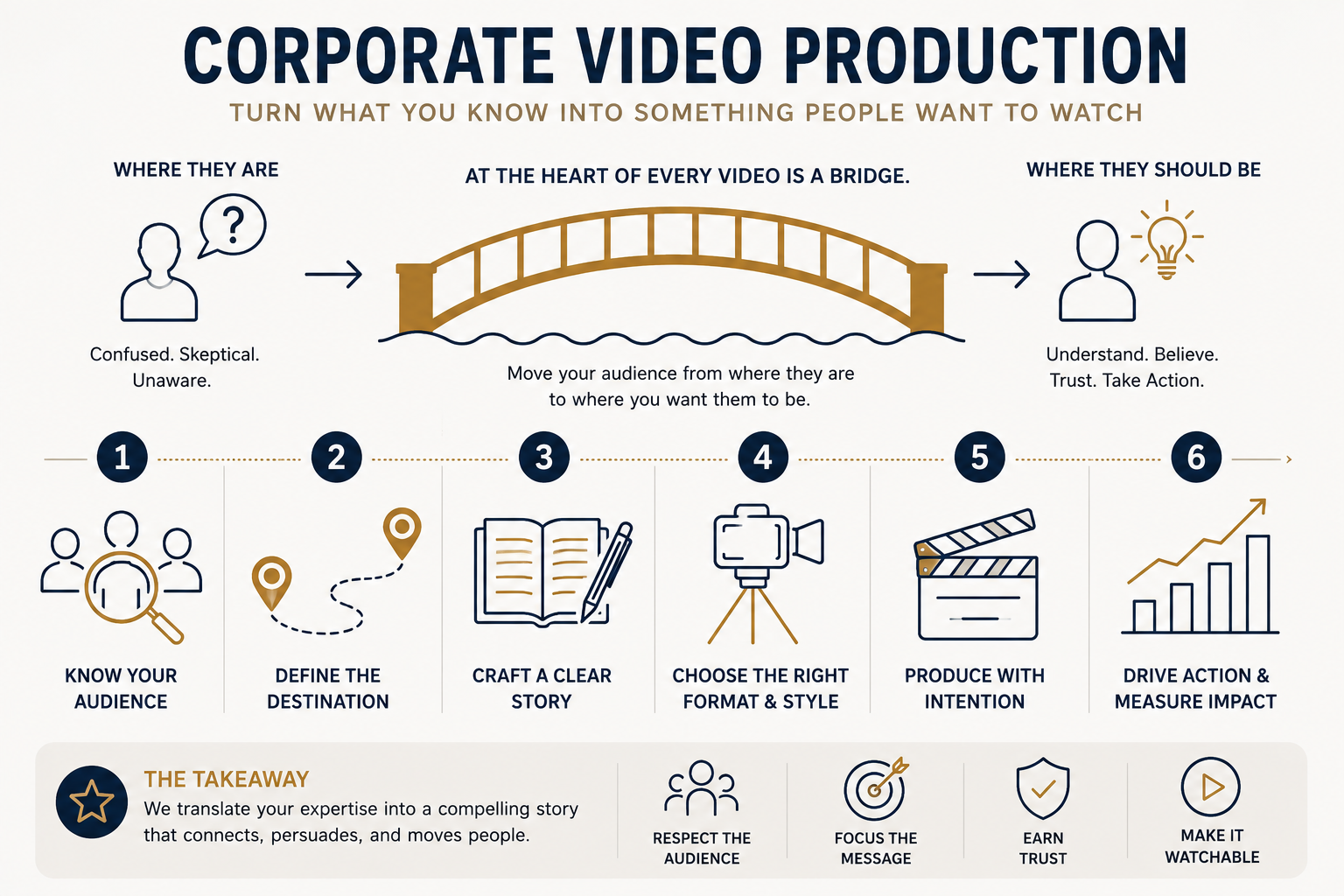
The viewer begins in one place. They may be uninformed, skeptical, distracted, confused, unmotivated, or unaware that a problem exists.
The video is supposed to help them arrive somewhere else. They should understand, believe, remember, trust, or act.
That makes almost every corporate video, at heart, a sales video.
The sale may be a product. It may be an idea. It may be a behavior. It may be a new way of seeing the organization.
The first job of video strategy is to define that bridge.
Where is the audience now? Where should they be when the video ends?
If those two points are unclear, the production can become very expensive decoration.
A beautiful video with no destination is still lost.
Start with the audience, not the camera
It is interesting how quickly a conversation about video becomes a conversation about production.
How many cameras? Which locations? Will there be animation? Should we use a drone?
Those questions matter eventually.
They are not the place to begin.
Start with the viewer.
Who are they? What do they already know? What do they believe? What might keep them from accepting the message? How much attention are they likely to give you? Where will they watch? What should happen after they finish?
A three-minute film shown to employees at a leadership conference lives in a different environment than a thirty-second social video watched without sound. A technical training series for an experienced ship crew has different obligations than a brand film introducing a company to prospective clients.
The audience determines the language, length, pace, format, visual style, and amount of explanation required.
It also determines what should be left out.
That may be the hardest part.
Corporate teams often want the video to contain everything because everything feels important from inside the organization.
Every department wants its sentence. Every stakeholder wants a feature represented. The message becomes crowded with facts that are individually accurate but collectively impossible to remember.
The audience does not need everything you know.
They need the right things in the right order.
Do not begin by copying a format
Most clients have a general idea of the kind of video they need. A brand film. A training video. A customer story. An executive message. A recruitment piece. An event opener.
That is a useful starting point. It should not become a creative prison.
One of the easiest ways to make an ordinary corporate video is to find another company’s video and say, “We want one like that.”
There is nothing wrong with references. They help communicate tone, pace, visual style, and ambition.
But copying a format without understanding why it worked usually produces a weaker version of someone else’s idea.
The better question is not, “What kind of video should we make?”
It is, “What is the most effective way to move this audience?”
Sometimes the answer crosses traditional categories.
When Marriott International developed its How Your Hotel Works program, the organization needed to teach property owners and general managers the fundamentals of hotel engineering.
That sounds like a training video.
The problem was that it could not feel like one.
The audience needed useful information, but another predictable corporate training module was unlikely to hold their attention. The solution combined training, brand storytelling, personality, and entertainment.
It still taught. It simply did not announce itself as homework.
The format should serve the message.
The message should not be forced into the first format someone recognizes.
The corporate video production process
Every project is different, but strong corporate video production usually moves through the same major phases:
- Discovery and strategy
- Concept development
- Pre-production
- Production
- Post-production
- Review and approval
- Delivery and distribution
These phases are connected.
A decision made during discovery affects the script. The script affects the locations. The locations affect the schedule. The footage affects the edit. The distribution plan affects the length and format of the final deliverables.
Video production is not a sequence of isolated services.
It is one long series of creative decisions.
Discovery: finding the real assignment
The first conversation should not be about equipment.
It should be about the problem.
Why does the video need to exist? Who asked for it? Who needs to approve it? What does the audience need to understand? What has already been tried? Where will the video be shown? How long will it remain useful? How will success be recognized?
Clients sometimes undervalue this part of the process because it does not look like production. No one is carrying a camera. Nothing has been edited. There is no dramatic footage to show.
But discovery is where the production team determines what it is actually making.
The original request may be, “We need a video about our new service.”
The real assignment may be, “Our customers do not understand why this service is different.”
Those are not the same project.
The first describes a subject. The second identifies a communication problem.
A creative team should keep asking questions until the problem becomes clear enough to solve.
The camera records the answer.
The conversation finds it.
Concept development: deciding how the idea should feel
Once the audience and objective are clear, the team can begin shaping the creative concept.
This may include:
- The central idea
- Story structure
- Visual approach
- Tone
- Script or interview framework
- Locations
- Casting or subject selection
- Music
- Graphics and animation
- Runtime
- Deliverable formats
Concept development is where strategy becomes something people can imagine.
Should the video feel intimate or cinematic? Should the story be carried by interviews, narration, observed action, animation, or a combination? Does the audience need evidence, emotion, instruction, or all three?
What is the one idea that should survive after the details fade?
The strongest concepts usually sound simple when they are finished.
Getting there may not be simple at all.
Clarity is often the result of removing good ideas that do not belong in this particular video.
Pre-production: where expensive problems become inexpensive decisions
Pre-production turns the concept into a plan.
Depending on the project, that may involve:
- Research
- Scripting
- Pre-interviews
- Storyboards
- Shot lists
- Location scouting
- Production schedules
- Crew planning
- Talent coordination
- Travel and logistics
- Wardrobe and props
- Legal and brand review
- Equipment planning
- Safety considerations
- Contingency plans
This work rarely receives the same attention as filming.
It deserves more.
A location may look perfect but have uncontrollable noise. An executive may be available for only twenty minutes. A critical operation may happen once each day. A facility may require safety training before the crew can enter. A ship may be moving through the Caribbean while the production schedule is moving with it.
Those details do not become less important because they are discovered late.
They simply become more expensive.
For Royal Caribbean International, Five Stone produced training content aboard working cruise ships at sea. The crew had to capture real environments and real processes while respecting ship operations, schedules, safety requirements, passengers, and the limitations of production on a moving vessel.
The result was not created by showing up with good cameras. It required creative thinking and serious logistical planning before anyone pressed record. The training program ultimately received award recognition and helped improve crew confidence and preparation.
Production gets the photographs.
Pre-production makes the photographs possible.
Scripting without losing the human voice
Some videos need a complete script. Others need a clear structure with room for real people to speak naturally.
The right choice depends on the purpose, speaker, and format.
Narration, animation, product explainers, safety content, and tightly timed event media often benefit from precise scripting. Every word may need to carry information, match a visual, or fit an exact runtime.
Interviews are different.
Trying to script an interview subject word for word usually removes the thing an interview is supposed to provide: a human response.
Scripted answers sound like scripted answers.
The speaker begins thinking about accuracy instead of meaning. Their voice changes. Their eyes search for remembered language. They become focused on delivering the approved sentence rather than communicating with another person.
The facts may survive.
The person disappears.
A good producer prepares the subject without prescribing every word. They help the interviewee understand the purpose, likely topics, and audience. Then they create enough comfort and curiosity for something honest to happen.
Prepared is good.
Performed is different.
Why corporate interviews fail
Two problems appear repeatedly in corporate interviews.
The first is overpreparation.
Someone writes the perfect answer, sends it to the interview subject, and asks them to memorize it. By the time filming begins, the subject is trying to retrieve language instead of having a conversation.
The second is assigning the interview to someone inside the company simply because that person knows the topic.
Subject knowledge is useful.
Interviewing is a different skill.
A good producer or interviewer will research the organization, understand the objective, prepare a sequence of questions, listen closely, recognize incomplete answers, and know when to follow something unexpected.
They also know that the first answer is not always the real answer.
Sometimes the useful moment comes after the subject believes the question is finished. Their shoulders relax. They stop trying to sound impressive. They explain what actually happened.
That moment cannot be extracted from a questionnaire.
Interviewing is not reading questions from a list.
It is listening for the story underneath the answer.
Production: protect the plan, stay open to the moment
Production is when the crew captures the performances, interviews, environments, actions, and details that will become the final piece.
Good production requires technical discipline. The image should be intentional. The audio should be clean. The lighting should support the environment. The crew should work efficiently. The footage should give the editor what the story requires.
But discipline should not eliminate discovery.
Some of the best ideas happen during production.
A location reveals something the team could not see in photographs. An interview subject tells a story no one expected. A technician notices a visual detail that becomes the opening shot. A planned scene feels false, while an unplanned interaction contains exactly the emotion the video needs.
Everyone on a strong production crew should be thinking creatively.
The director may own the larger vision, but camera operators, audio technicians, producers, assistants, and client stakeholders can all recognize an opportunity.
A production plan gives the team direction.
It should not make them blind.
The story may show you something better than the storyboard.
Be ready to notice.
Field production usually beats the studio
Studios are useful.
They provide control over sound, lighting, weather, backgrounds, schedules, and repeatability. Some concepts genuinely require them.
But companies often assume a studio is the more professional choice simply because it looks like “production.”
It is not always the better storytelling choice.
Do not pay to film in a studio unless the message benefits from being in a studio.
Field production gives the audience something increasingly valuable: reality.
The actual factory. The real hotel. The working kitchen. The office where the decisions happen. The ship where the crew performs the task.
Those environments contain details that cannot be manufactured easily. They help people understand scale, culture, process, and context. They also give the editor a richer visual vocabulary.
In a world filled with synthetic images, virtual environments, and polished content that could have been created anywhere, reality has texture.
People can feel the difference.
Field production can also be more cost-effective than building an artificial version of a place that already exists.
One exception: a real location that destroys the schedule, compromises audio, creates safety problems, or cannot visually support the message may not be worth the authenticity.
“Real” is not automatically good.
But when the environment is part of the story, let the audience see it.
Post-production: where the story reveals itself again
Post-production usually includes:
- Footage organization
- Editing
- Music
- Sound design and mixing
- Color correction
- Motion graphics
- Animation
- Titles and captions
- Voiceover
- Versioning
- Review exports
- Final mastering
This is not merely where the footage is assembled according to the script.
It is where the story is tested.
Ideas that seemed clear on paper may feel slow onscreen. A short interview response may carry more emotional weight than a longer approved statement. Two images captured hours apart may create a new connection when placed beside each other.
Sometimes the edit brings together something no one fully anticipated during production.
That is not evidence that the plan failed.
It is evidence that creative work remains alive throughout the process.
The editor should understand the original objective well enough to recognize a better route to it.
Editing is not the final technical step.
It is another stage of writing.
The first draft is the most important conversation
Feedback is one of the most difficult parts of corporate video production.
The challenge is rarely that clients have opinions. They should.
The challenge is that feedback often moves through an organization in the wrong order.
A project team reviews the first cut. Changes are made. Another department sees the second cut. More changes are made. Then the senior executive who owns the message watches the video for the first time and questions the direction everyone else has been refining.
The project is now several rounds into solving the wrong problem.
Whenever possible, the first viewing should include the important stakeholders.
Ideally, everyone watches together in person or by video meeting. The creative team can explain the reasoning behind the draft. Stakeholders can react to the same version at the same time. Conflicting opinions become visible immediately.
Most importantly, the team can discuss what is working before creating a list of what should change.
The first draft is not a nearly finished product with a few mistakes.
It is the first time everyone can respond to the same living version of the idea.
That makes the first review more than an approval step.
It is a creative meeting.
Once the team agrees on what the video is, the remaining revisions are usually faster and easier.
How to give useful video feedback
Good feedback explains the problem.
Weak feedback prescribes a solution without explaining why.
- “Replace this shot” may be correct.
- “This section makes our manufacturing process feel smaller than it is” gives the editor something more valuable.
- “Make the music more exciting” is subjective.
- “The opening does not create enough momentum for an audience entering a sales meeting” connects the reaction to the video’s purpose.
Useful feedback might address:
- Accuracy
- Clarity
- Tone
- Pace
- Brand alignment
- Audience understanding
- Missing information
- Emotional response
- Legal or compliance concerns
- The intended action
Someone should consolidate feedback before sending it to the creative team.
Five stakeholders should not send five separate documents with contradictory instructions and expect the editor to determine which executive outranks the others.
The production company should help manage this process, but the client needs a clear decision maker.
When everyone can approve, no one is really in charge.
How long should a corporate video be?
As long as it remains useful.
No longer.
There is no universal ideal runtime.
A complex training module may need ten minutes. An event opener may need ninety seconds. A customer story may earn four minutes because the subject and stakes are compelling. A social edit may need to communicate its premise before the viewer decides whether to turn on the sound.
Length is not the enemy.
Unnecessary length is.
The right question is not, “Will people watch a five-minute video?”
It is, “Have we earned the next minute?”
Audiences will watch long stories that continue rewarding their attention. They will leave a thirty-second video that never gives them a reason to care.
Make it as short as possible.
But not shorter than the idea.
Plan for where the video will live
A video is not finished simply because the master file has been delivered.
The distribution environment should influence production from the beginning.
Will the video appear:
- On a website?
- At a corporate event?
- In a learning platform?
- On social media?
- In a sales presentation?
- In paid advertising?
- On screens without sound?
- In multiple countries or languages?
- In vertical, square, and horizontal formats?
A single production may need several versions:
- Full-length master
- Short promotional cut
- Vertical social edits
- Captioned version
- Clean version without graphics
- Event playback version
- Alternate calls to action
- Translated or subtitled versions
- Individual training chapters
Planning those deliverables early helps the crew capture footage that works across formats. It also prevents the editor from trying to manufacture a vertical composition from a shot designed only for a wide screen.
One shoot can create an entire library.
But only if the library is part of the plan.
How to measure whether a corporate video worked
Views are useful.
They are not the same as impact.
The right measurement depends on what the video was supposed to move.
For a training video, success may involve completion, retention, confidence, compliance, or improved performance. For a recruitment film, it may involve qualified applicants and stronger candidate understanding. For a sales video, it may involve inquiries, conversions, shortened sales conversations, or better-qualified prospects. For an executive message, success may be clarity and alignment. For an event film, it may be how the audience responds in the room.
Not everything important can be captured in an analytics dashboard.
But the team should still define what success looks like before production begins.
Otherwise, the only available evaluation becomes, “Did everyone like it?”
Approval matters.
Outcome matters more.
Choosing a corporate video production partner
A capable production company should know cameras, lenses, lighting, sound, editing, color, graphics, and delivery specifications.
That is the technical baseline.
Pay attention to what happens before those subjects dominate the conversation.
Does the team ask about the audience? Do they want to understand the business problem? Can they challenge the curse of knowledge without dismissing the client’s expertise? Can they explain why a creative choice supports the objective?
Do they understand corporate stakeholders and approval processes? Can they make executives and employees comfortable on camera? Will they remain open to discoveries during production and editing? Do they know when a studio is useful and when the real environment tells a better story?
Then ask yourself a simpler question.
Do these people make your ideas clearer?
The best creative partner will not simply agree with everything you bring them. They will listen carefully, protect what matters, question what does not, and help the organization communicate with people who do not live inside it every day.
The client knows the subject.
The production team knows how to help an audience enter it.
That relationship is where the work becomes valuable.
Corporate video production in Dallas and beyond
Five Stone Creative is based in Dallas–Fort Worth and produces corporate video projects across the country and around the world.
Our work has taken us into hotels, offices, restaurants, industrial environments, live events, city streets, and working cruise ships at sea.
That range matters because corporate stories rarely live in only one kind of place.
A full-service video production team should be able to move comfortably between boardrooms and loading docks, executive interviews and active operations, creative development and technical execution.
The equipment changes.
The central job does not.
Understand what the organization knows. Understand what the audience needs.
Then build the bridge between them.
The real product
A corporate video is not a camera pointed at expertise.
It is expertise made understandable.
The production process matters because every phase gives the team another opportunity to clarify the idea, strengthen the story, and respect the audience’s attention.
Discovery finds the real assignment. The concept gives it shape. Pre-production makes it possible. Production captures what is real. Editing reveals what matters. Feedback brings the organization into alignment.
The final file is only the visible result.
The real product is movement.
The viewer begins in one place.
If the video works, they do not end there.