The Nonprofit Video
Production Guide
How to Create Mission-Driven Videos That Inspire People to Act
People who work for nonprofits usually believe deeply in the mission.
They understand the challenge. They have seen the need firsthand. They know the programs, the people and the progress being made.
That belief is essential.
It can also create a blind spot.
When you live close to a mission, it is easy to assume other people will care once they understand what the organization does.
That leads many nonprofits to approach video with a simple objective:
Tell our story.
Or:
Show our work.
Those are reasonable starting points. They are not complete communication goals.
Telling your story is not the same as moving your audience.
A successful nonprofit video begins by understanding who is watching, what they currently believe and what action the organization needs them to take.
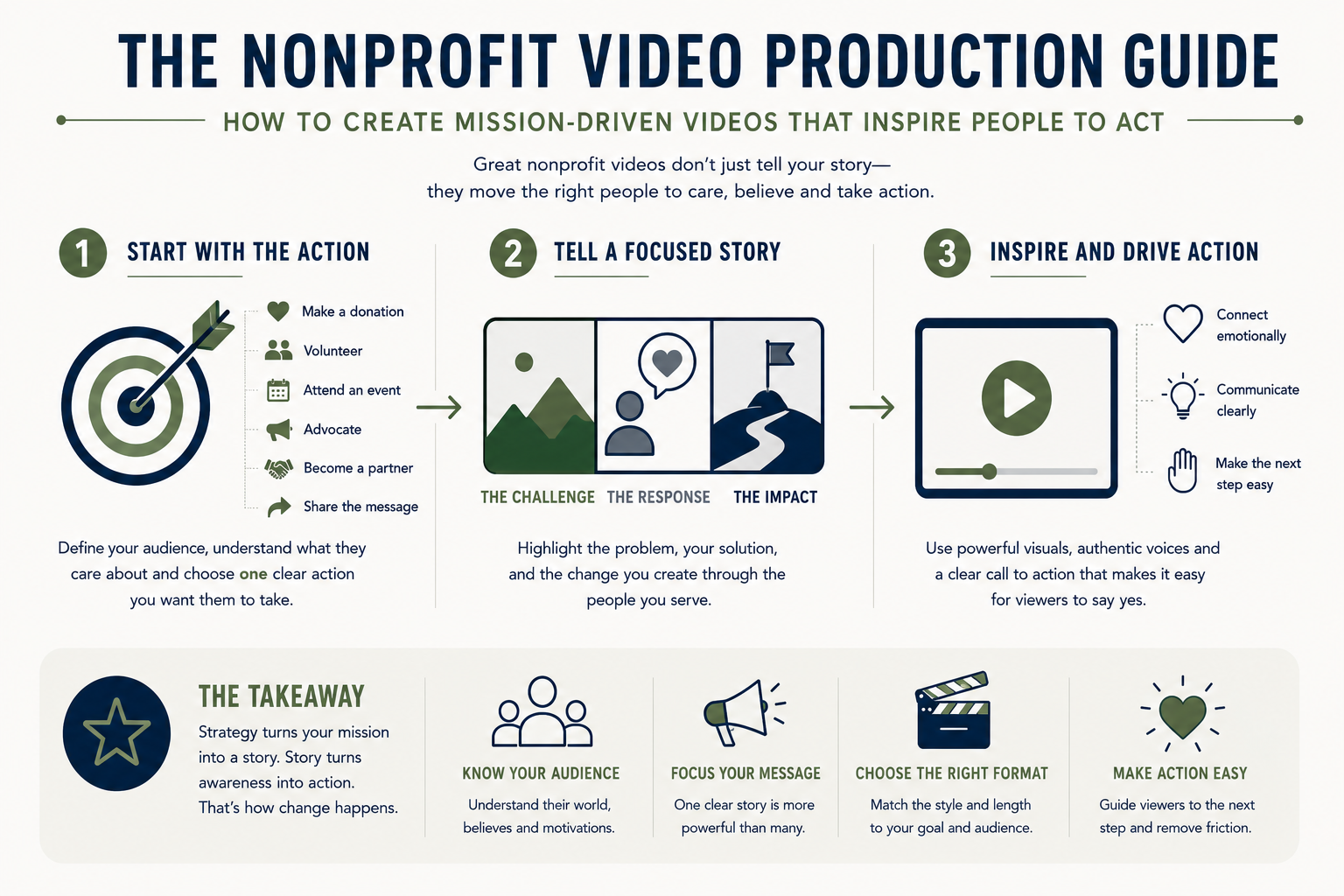
Start with the action
A nonprofit video might ask someone to:
Make a donation
Volunteer
Attend an event
Advocate for a cause
Join a program
Become a corporate partner
Share the message
Trust the organization
Understand an unfamiliar challenge
All of these are worthwhile.
Trying to accomplish all of them in one video is usually where the trouble begins.
Getting someone to care may require a different story than getting an existing supporter to donate. Recruiting a volunteer is different from asking a legislator to act. Introducing the organization to a new audience is different from asking a longtime donor to increase their commitment.
The audience and the action should be defined before anyone discusses cameras, locations or interview subjects.
Ask:
Who is this video for?
What do they already know?
What do they believe now?
What might keep them from acting?
What should they feel?
What should they understand?
What should they do next?
These questions are pre-production work.
They are also where much of the video’s value is created.
Emotion can open the door. Clarity tells people what to do next.
Define the challenge before telling the story
Nonprofits are often under-resourced. Staff members carry multiple responsibilities, urgent needs compete for attention and every program deserves to be represented.
That can make narrowing the message feel almost impossible.
If the organization serves several communities, leaders may want each one included. If donors funded different initiatives, everyone may want their contribution recognized. If several departments participate in the project, each may want time to explain its work.
The final video becomes accurate.
It also becomes unfocused.
A viewer does not need to understand every part of the organization before taking one meaningful action. They need a clear path into the mission.
An outside creative partner can be valuable because they are not carrying years of internal context. They can ask the questions a new viewer would ask, identify what is most compelling and help the organization choose a direction.
This is not about oversimplifying the mission.
It is about creating a way into it.
Story and footage are not the same thing
Nonprofits often have access to powerful footage.
Volunteers at work. Families receiving support. Medical teams serving patients. Students learning. Communities rebuilding. Donors celebrating progress.
Those images can be moving.
They do not automatically create a story.
A voiceover paired with strong footage may be exactly what a project needs. It can explain the mission efficiently, establish emotion and support a fundraising presentation.
Documentary-style storytelling is different.
An in-depth story gives the audience time to understand a person, a choice or a challenge. It brings the viewer into the nuance and humanity of the situation. Instead of simply seeing what the organization does, the audience begins to understand why the work matters.
Neither format is universally better.
The right choice depends on the audience, action, budget and viewing environment.
A two-minute gala film may need to move quickly toward a specific ask. A longer documentary may be more appropriate for advocacy, education or a major campaign. Short social content may focus on one moment or idea rather than explaining the entire mission.
The production team should help determine which form serves the goal.
Beautiful footage can attract attention.
A story gives that attention somewhere to go.
Put the beneficiary at the center when possible
Whenever it is appropriate, the person who benefits from the work is often the strongest central character.
They can make a complex issue human. Their experience can show the need, the organization’s role and the difference support creates.
But this kind of storytelling requires care.
Stories involving hardship, illness, poverty, trauma, children or vulnerable communities should not be approached like ordinary marketing content. The subject is a person before they are a character in a video.
The production team should consider:
- Whether the participant can provide informed consent
- What information should remain private
- How the story may affect the person later
- Whether children or vulnerable adults require additional protection
- How the interview will be conducted
- Which moments are appropriate to film
- Whether the final edit preserves the subject’s dignity
- How and where the video will be distributed
The most dramatic version of a story is not always the most responsible version.
An experienced interviewer knows how to explore difficult experiences without treating pain as content to be extracted. They also understand that resilience, humor, relationships and ordinary details may reveal more humanity than focusing exclusively on hardship.
The subject does not owe the production their most painful moment.
Trust creates better interviews.
It also creates better stories.
Do not script the interview
Scripted interview answers are almost always a bad idea.
They sound careful because they are. The subject begins thinking about the exact words instead of the experience behind them. Natural pauses disappear. Emotion becomes performance.
The goal is not to make someone memorize the right answer.
It is to help them feel safe enough to give an honest one.
We like to conduct practice interviews in person or by video call before production. This serves two purposes.
First, it reduces anxiety. The subject sees that the interview is simply a conversation.
“It will be just like this when the cameras are on. Easy.”
Second, it prepares the interviewer. We learn the basic story, identify sensitive areas and understand which ideas deserve more time during production.
When the cameras roll, the conversation already has a foundation. As the subject relaxes, thoughtful follow-up questions can uncover moments nobody expected.
That is where many of the best stories appear.
A good interviewer prepares extensively.
Then they listen closely enough to leave the prepared questions behind.
Choose an experienced storytelling team
Nonprofit storytelling demands more than technical skill.
A production company may know how to light an interview and capture beautiful footage without knowing how to guide a sensitive conversation. It may create an emotionally powerful film that does not support the fundraising ask. It may understand fundraising but present the people being served as symbols instead of human beings.
Review work that resembles the project you are planning.
If the video involves medical care, children, grief, poverty or personal hardship, ask specifically about the team’s experience with sensitive subjects. Look for interviews that feel natural and edits that allow people to retain their complexity.
Ask the production company:
- How will you prepare the interview subjects?
- Who will conduct the interviews?
- How do you approach sensitive stories?
- How will you identify the central narrative?
- What will you need from our staff?
- How will the call to action shape the edit?
- Who will review the video before it is released?
The quality of the camera matters.
The judgment of the people behind it matters more.
Tell the production company your budget
Nonprofits sometimes hesitate to reveal a budget because they worry the proposal will simply expand to consume it.
A trustworthy creative partner should use the budget to make better decisions.
Share a realistic range early. Explain what is essential, what would be helpful and what the organization can contribute internally.
The production company can then decide how to scale the work while protecting the elements that matter most.
That may mean:
- Filming in one location instead of several
- Completing several interviews in one production day
- Using real environments instead of renting a studio
- Building the story around available footage
- Reducing crew size where appropriate
- Choosing a simpler visual approach
- Creating several deliverables from one production
- Prioritizing one excellent primary video over several weaker ones
Ask whether nonprofit pricing or other budget accommodations are available. Discounts may be possible, but they should not replace honest scope discussions.
The goal is not to make every part of the production inexpensive.
It is to make the video good where it counts.
For a deeper explanation of production budgets, see Understanding Video Production Costs.
Create more than one deliverable
A well-planned production can support much more than one finished video.
The same interviews and footage may become:
- A primary fundraising film
- Short donor stories
- Social-media clips
- Volunteer recruitment content
- Event openings
- Website videos
- Campaign updates
- Corporate partnership materials
- Grant-supporting content
- Internal training or mission videos
- Short vertical edits
- Follow-up content after an event
This does not mean filming once creates unlimited content at no additional cost. Each deliverable still requires planning, editing, graphics and review.
But it is far more efficient to identify those needs before production.
The interview questions can support several edits. The crew can capture horizontal and vertical compositions. Additional scenes can be filmed while the team is already onsite. Releases can cover the intended uses.
One production day can work much harder when everyone knows what it needs to produce.
Address approvals before production
Approval can become a major obstacle in nonprofit video production.
The executive director has a perspective. The development team understands the fundraising goal. Program staff know the people and work. The board may want oversight. A major donor may be sponsoring the production and expect input.
All of those voices may be legitimate.
They cannot all direct the edit independently.
Before production begins, determine:
- Who owns the project
- Who provides factual review
- Who protects the fundraising objective
- Who approves the story
- Who has final authority
- When the board or donor will be involved
- How feedback will be collected
- How many revision rounds are included
This is particularly important when the budget limits the number of revisions, which is common in nonprofit production.
A room full of people giving disconnected notes does not create a stronger film. It creates a longer edit.
Whenever possible, the key stakeholders should review the first cut together. Once everyone can see the same video, it becomes easier to discuss what is working, what is missing and what needs to change.
The first edit should start a focused conversation.
It should not begin a voting process.
Plan distribution before production
Nonprofit videos are used in many places:
- Fundraising events
- Websites
- Email campaigns
- Social media
- Donor meetings
- Grant presentations
- Volunteer recruitment
- Community education
- Corporate partnership outreach
- Advocacy campaigns
The right distribution plan depends on where the audience is most likely to encounter the content at a moment when they can take the desired action.
A video shown during a gala has a focused audience, a controlled environment and an immediate opportunity to donate. A social video competes with everything else on the viewer’s phone. A donor-meeting video may need to begin a conversation rather than complete the entire case for support.
The viewing environment should influence the length, pacing, framing, captions and call to action.
Do not finish the video and then ask where it belongs.
Decide where it needs to work before deciding what it should become.
Why fundraising events can move mountains
A well-produced fundraising event creates something most communication channels cannot:
A shared moment.
The audience is gathered for a reason. Speakers, live production, video and the fundraising ask can all support the same emotional and intellectual journey. The video does not need to explain the entire organization. It needs to prepare this audience for the action available in this room.
That is why targeted event content can be so effective.
The presentation before the video matters. The lighting after it ends matters. The person who makes the ask matters. The instructions for donating matter.
The video is not an isolated asset.
It is part of the experience that moves the audience.
For more on building the complete production around the purpose of an event, see The Complete Guide to Corporate Event Production. The same production principles apply to nonprofit galas, donor events and mission-driven gatherings.
One day inside a working clinic
Our work with Cure Duchenne brought many of these ideas together.
We produced a feature video for the organization’s Dallas gala. The goal was not simply to explain Cure Duchenne’s work. The film needed to help the audience understand the human stakes and respond during the event.
The production presented a significant challenge. Everything had to be filmed in a single day with one crew inside a working Cure Duchenne clinic.
We had to respect the clinical environment, work around real activity, conduct meaningful interviews and gather enough footage to build a complete story. There was little room for wasted time and no reason to make the production larger than the mission required.
The final film helped the gala set an all-time fundraising record for the organization.
That outcome did not come from showing every part of Cure Duchenne’s work.
It came from finding the clearest path between the mission, the audience and the action.
Questions to ask a nonprofit video production partner
Before selecting a production team, ask:
- How will you help us define the audience and call to action?
- Who will conduct the interviews?
- What experience do you have with sensitive or vulnerable subjects?
- How will you protect the dignity and privacy of participants?
- What can we realistically accomplish within our budget?
- How can the footage support multiple deliverables?
- What should our staff handle, and what will your team provide?
- How will stakeholder feedback and final approval work?
- How should the intended distribution shape the production?
- Can you show us nonprofit work with a goal similar to ours?
Listen to the questions the production company asks in return.
A team focused only on the filming will ask about dates, locations and deliverables.
A creative partner will also ask who needs to be moved and what you need them to do.
The real purpose of nonprofit video
A nonprofit video should communicate the mission.
But communication is not the finish line.
The video should help a person understand why the mission matters to them, then give that understanding somewhere to go.
That may mean donating, volunteering, attending, advocating or simply seeing an issue differently for the first time.
Five Stone Creative provides video production services for nonprofits and mission-driven organizations in Dallas-Fort Worth and nationwide. We help clients define the challenge, find the human story and create content designed to inspire meaningful action.
Tell the story.
Protect the people inside it.
Make the next step clear.
That is how video moves a mission forward.