
The Corporate Event
Photography Guide
Professional Photography for Conferences, Meetings and Brand Experiences
Event photography sounds straightforward.
Hire a photographer. Give them the schedule. Let them document what happens.
That approach will probably produce photographs.
It may not produce the photographs you need.
A corporate event can generate content for social media, internal communications, sponsor reports, future event marketing, recruiting, public relations and company archives. It can give attendees a professional headshot, help speakers promote their appearances and show people who were not there what they missed.
But none of that happens automatically.
The real question is not whether your event needs a photographer.
It is what the photographs need to accomplish.
Event photography is more than documentation
Corporate event photography is often described as a combination of candids, speakers, room photographs and posed groups.
Those are all important. They are also only categories.
A photograph of an audience tells us people attended. A photograph of an audience leaning forward, laughing or responding to a speaker tells us something happened.
A picture of a stage documents the production. The right picture can communicate the scale, energy and personality of the entire event.
The difference begins with purpose.
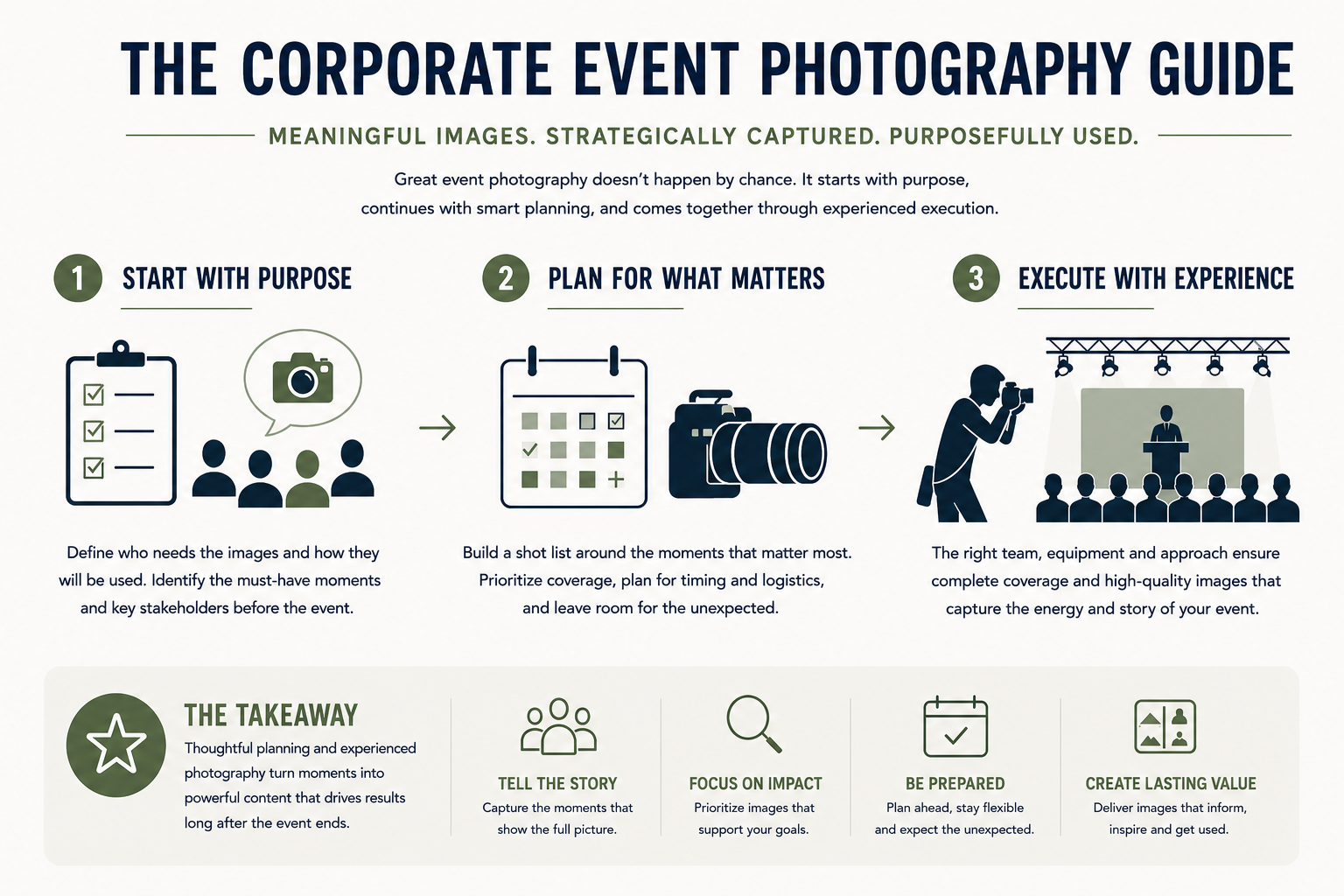
Before building a photography plan, identify the primary stakeholders and how they intend to use the images.
Is the marketing team promoting next year’s event?
Does the social team need photographs while the event is happening?
Does leadership want to demonstrate company culture?
Do sponsors need evidence of participation and visibility?
Would professional headshots create value for attendees?
Is the organization building a long-term content library?
Usually, the answer includes several of these.
A photographer cannot prioritize everything equally. The team needs to know what matters most before the event begins.
A full gallery is not necessarily a useful gallery.
Start with the images you will need later
“Capture the event” is not a photography brief.
A useful plan begins by imagining the work that happens after the conference. Someone will need a hero image for next year’s registration page. Someone will build a recap presentation. Someone will ask for a photograph of the CEO with the presentation visible behind them.
A sponsor may want images of its activation with people actually participating. The social team may need a strong audience photograph before lunch.
These needs should be discussed before the photographer arrives.
A corporate event photography plan may include:
- Venue and room photographs before attendees arrive
- Registration and arrivals
- Environmental branding and signage
- Keynote speakers
- Panel discussions
- Breakout sessions
- Audience reactions
- Networking and informal conversations
- Awards and recognition
- Sponsor activations
- Executive and stakeholder interactions
- Group photographs
- Behind-the-scenes production
- Evening events
- Attendee headshots
- Images selected for same-day delivery
A shot list is helpful, but it should not become a rigid scavenger hunt. Events move quickly. Schedules change. Meaningful moments happen that nobody predicted.
The photographer needs clear priorities and enough freedom to respond.
The plan tells us what cannot be missed.
Experience tells us what nobody knew to request.
One photographer cannot be everywhere
One of the most common mistakes in event photography is underestimating the amount of simultaneous coverage an event requires.
A single photographer may be able to cover a keynote, reception or smaller meeting beautifully. The challenge begins when a keynote ends while a sponsor activation opens, executives gather for a photograph and three breakout sessions begin in different rooms.
At that point, the question is not whether the photographer is talented.
The question is which important moment will be missed.
Consider adding photographers when:
- Sessions happen simultaneously
- The event occupies multiple rooms or venues
- Important stakeholders need dedicated coverage
- Headshots are happening during the program
- Social-media images must be delivered quickly
- Sponsors require specific photographs
- The schedule contains overlapping meals, receptions or activations
- Missing a significant moment is unacceptable
There is also a more practical question planners should ask:
Is it okay if certain things are missed?
Sometimes the honest answer is yes. A smaller budget may be better served by one excellent photographer following a clear list of priorities than by stretching the event to cover everything.
If missing coverage would create a real problem, add another photographer.
If it would not, save the money.
Good planning does not mean buying the largest team possible. It means understanding the tradeoff before show day.
How event photography is commonly priced
Professional event photographers should be comfortable working on day rates, much like other members of the production team.
A standard event day often includes up to ten hours of coverage, with overtime beginning after that point. Exact terms vary, so the proposal should define:
- The number of photographers
- The number of event days
- The hours included each day
- Overtime rates
- Travel and related expenses
- Editing and delivery
- Same-day image requirements
- Headshot coverage
- Usage rights
- Any additional equipment or assistants
Editing is often quoted as a flat project cost rather than an open-ended hourly estimate. That gives the client a clearer understanding of the total investment.
The biggest pricing variables are generally not camera models. They are the number of days, the number of photographers and the speed at which the images need to be delivered.
You are paying for coverage.
Coverage is a function of time, access and people.
A corporate event photographer should know how to disappear
Wedding photographers often help direct the day after the ceremony. They arrange groups, move people into position and take a visible role in keeping things progressing.
Corporate event photography is different.
Most of the time, the photographer should blend into the event. They need to anticipate moments, move quietly and create strong images without becoming part of the program.
There are times when direction is appropriate. Group photographs, headshots and planned executive moments require confidence and efficiency. But a keynote is not a portrait session. The photographer should not distract the speaker, block the audience or interfere with the production to get a better angle.
The strongest event photographers know when to take control and when to disappear.
This is one reason a talented wedding, portrait or commercial photographer is not automatically the right person for a conference.
Event photography requires a specific awareness of schedules, audience movement, stagecraft and production etiquette.
If a photographer cannot show you extensive work that looks like the event you are planning, keep looking.
Photography and event lighting must work together
Lighting has an enormous effect on event photography.
A photographer should communicate with the lighting team before the event, understand the design and identify any potential challenges. That does not mean the entire room should be redesigned around the photographs.
We are not changing the visual look of a keynote simply to accommodate the photographer.
A strong event photographer works with the environment that supports the audience experience. They understand color, exposure, changing lighting conditions and how LED screens or projection will appear on camera. They bring the appropriate equipment and adjust without disrupting the event.
This is where having photography and live event production under one coordinated team creates real value. The photographer knows what the lighting designer intends. The production team knows where the photographer needs access. Both teams understand the run of show.
Communication matters because the best photograph often exists for less than a second.
Nobody should be arguing about camera positions when it happens.
Never hire two unrelated photographers for the same job
If an event needs two or more photographers, they should be part of the same team.
We have seen clients hire separate photographers independently, usually in an attempt to expand coverage or combine different styles. It gets ugly. Every time.
They compete for positions. They step into one another’s frames. They duplicate obvious moments while other parts of the event go uncovered. They may use completely different color, lighting and editing styles.
Most importantly, there is no shared coverage plan.
A coordinated photography team divides responsibilities before the event. Everyone understands the schedule, priorities and visual style. One person may anchor the general session while another covers breakouts, sponsor areas or attendee interactions.
More photographers do not automatically create better coverage.
Better coordination does.
Headshots can become one of the event’s most valuable services
A professional headshot station gives attendees something useful long after the conference ends.
For most people, that image will appear on LinkedIn, an internal company directory, a speaker profile or a professional biography. It should feel polished but still look like the person.
Professional, with personality.
That balance requires more than a backdrop and a camera.
At a conference with hundreds of attendees, a photographer may have only three or four minutes with each person. In that short window, they need to make the attendee comfortable, give useful direction and create a genuine expression.
Efficiency is everything.
The team should scout the location in advance, determine the background, plan the attendee flow and anticipate how natural light may change throughout the day. If the station relies on window light at 9:00 a.m., it may look completely different at 4:00 p.m.
A headshot plan should address:
- The number of attendees
- Available operating hours
- Expected participation
- Appointment scheduling or walk-up access
- The physical footprint
- Background and brand preferences
- Lighting consistency
- Attendee check-in
- Image selection
- Retouching
- Delivery timing
- Privacy and usage
A headshot station can also be sponsored, paired with personalized delivery or incorporated into a larger attendee experience.
Those elements can add value, but the photograph itself should remain the priority.
A novelty gets attention for a few minutes.
A good headshot may be used for years.
Same-day photography requires a workflow
Many organizations want images while the event is still happening.
That makes sense. A photograph posted during a packed keynote can create excitement and real-time FOMO for people who did not attend. An end-of-day gallery can support recap emails and give speakers something to share while the event is still current.
But images do not move directly from the camera to social media by magic.
They need to be transferred, reviewed, culled, edited and delivered. The faster the client needs a substantial number of polished images, the more planning and labor the process requires.
Options may include:
- A small set of social-media selects during the day
- Speaker photographs shortly after each session
- An edited end-of-day gallery
- A next-morning highlight collection
- A complete gallery after the event
- A dedicated onsite editor handling continuous delivery
If a photographer must stop shooting to edit, coverage pauses.
For larger events, the team can rotate photographers so one person processes images while others continue shooting. When the volume and turnaround expectations are high, a dedicated editor is usually the better answer.
Fast delivery is not a button. It is a staffing decision.
The client should also identify who receives the images and who approves them. A technically perfect workflow can still fail if photographs sit in an inbox waiting for a busy executive to respond.
Organize the library around how it will be used
A folder containing 2,000 photographs is not a content strategy.
At a minimum, event photographs can be organized by day and session title. For many clients, a contextual structure is even more useful:
- Keynotes
- Breakout sessions
- Audience reactions
- Attendees networking
- Awards
- Sponsors
- Headshots
- Environmental branding
- Behind the scenes
- Social-media selects
- Marketing highlights
There is no single correct system. A good corporate photography team should be able to organize delivery around the client’s workflow.
Marketing may want a tightly curated collection of the strongest images. The event team may want complete session coverage. Sponsors may need separate galleries. Internal communications may need images grouped around culture and employee participation.
The same photographs can serve different stakeholders, but only if people can find them.
A photograph nobody can find is barely an asset.
Before the event, confirm whether the client needs high-resolution files, web-ready versions or both. The agreement should also explain the organization’s usage rights and any restrictions on attendee, speaker or sponsor images.
These details are easier to resolve before someone needs a photograph for a campaign launching tomorrow.
Creative ways photography can add value
Traditional event coverage should come first. Once the essentials are protected, photography can become part of the attendee or sponsor experience.
Possibilities include:
Personalized attendee delivery
Technology can help attendees locate and receive photographs of themselves without searching through the entire gallery. Some systems use a selfie and facial matching to build a private collection.
This can encourage sharing and make the photography feel like an attendee benefit. It also requires thoughtful consent, privacy practices and data handling.
Sponsor photography packages
A sponsor may receive a dedicated collection showing its booth, signage, speakers and interactions with attendees. The goal is not merely to prove that a logo was present. It is to show that people engaged with the sponsor.
This can make post-event reporting more useful and support future renewals.
Live photo mosaics
Attendee photographs can become individual tiles in a larger branded image that grows throughout the event. The finished mosaic can support a conference theme, company milestone or nonprofit mission.
Like any activation, it should connect to the purpose of the event. “This looks cool” may be a fine starting point, but it is not much of a strategy.
Creative photography adds the most value when the experience and the resulting images are both useful.
One visual team is better than several vendors
Corporate events increasingly require photography, video capture, social content, livestreaming and full event production.
These services affect one another.
The photographers and video team may want similar positions. Lighting must support the room, the cameras and the livestream. An executive may be needed for an interview, a headshot and a rehearsal within the same hour. Social content may require files from several departments.
When those teams plan together, the event becomes easier.
Five Stone’s work on the Marriott Engineering and Facilities Conference is a strong example. Our role extended from theme, messaging and content capture through the conference’s multimedia production. Photography was not treated as an isolated assignment. It was part of a larger visual story built around what Marriott wanted its audience to experience and remember.
That shared understanding creates consistency, but it also improves logistics. Everyone works from the same schedule, knows the priorities and communicates when something changes.
The photographer should not just be near the production team.
The photographer should be part of the plan.
Questions to ask an event photography partner
Before hiring a photographer or photography team, ask:
- Can you show us extensive examples from events similar to ours?
- How many photographers do you recommend, and what might be missed with a smaller team?
- How do you build a coverage plan around our marketing and stakeholder needs?
- How do you coordinate with the production, lighting and video teams?
- What can you deliver during the event, and what staffing does that require?
- How will the final photographs be edited and organized?
- What usage rights are included?
Pay attention to the questions the photographer asks in return.
A strong partner will want to know more than the date, location and number of hours. They will ask who matters, what cannot be missed and what the images need to do after the event.
The real value of event photography
The event ends.
The room is cleared. The stage comes down. Attendees fly home. Within a few days, even the people who were there begin to remember it differently.
The photographs become the evidence.
They show what the organization built, who participated and how the experience felt. They help sponsors understand their value, attendees remember their connection and future audiences imagine themselves in the room.
That is why event photography should never be an afterthought.
Five Stone Creative provides professional event photography and videography for conferences, corporate meetings, nonprofit events, trade shows and brand experiences in Dallas-Fort Worth and nationwide. From comprehensive event coverage and attendee headshots to same-day marketing selects, we build the photography plan around what your organization needs the images to accomplish.
The photographer is not simply documenting what happened.
They are creating what the event will look like after it is over.